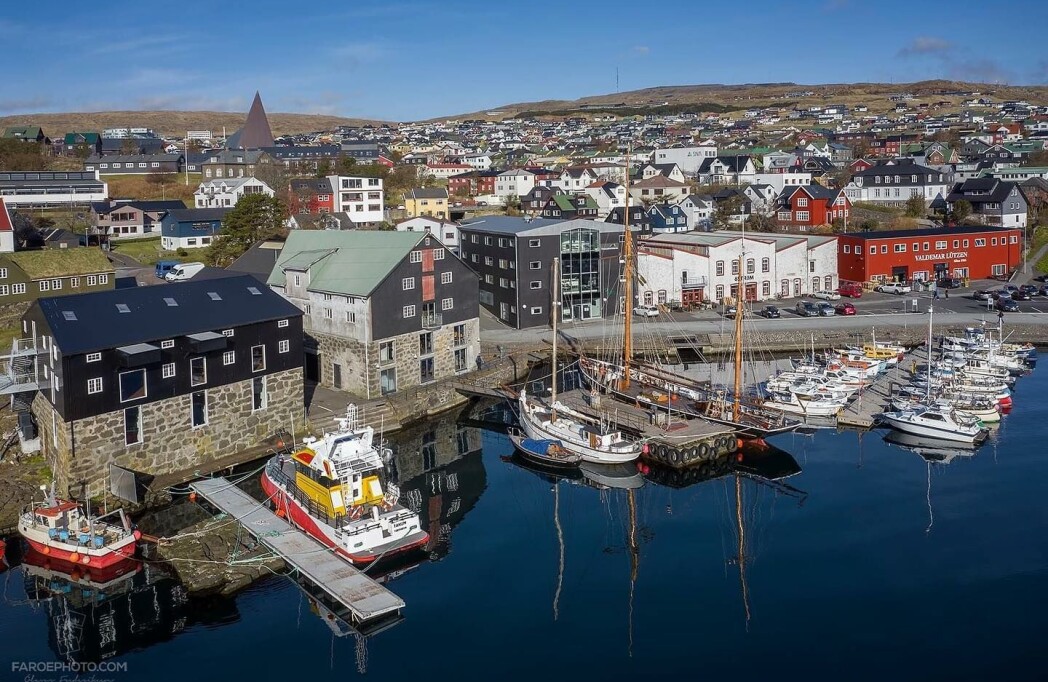
- There is continued progress in the Faroese economy, as there has been for the last several years. But we can see that the pace has slowed down a bit in the labor market compared to the years immediately after the pandemic, when there was very high activity.
This is stated by economist Nicolai Risager Christensen, one of the authors of a new analysis of the Faroese economy, in a Facebook post from the Nationalbank.
The National Bank of Denmark is the central bank for the entire Commonwealth and continuously monitors developments in the Faroese and Greenlandic economies.
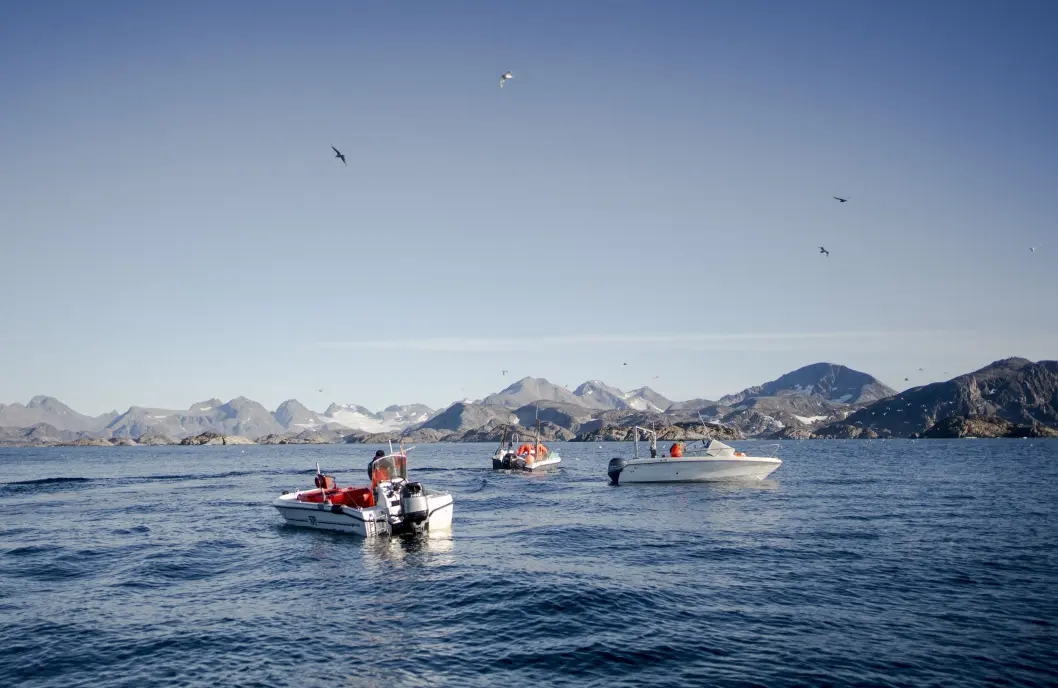
According to the analysis, the outlook for the Faroese economy is characterized by great uncertainty. The export sector in the Faroe Islands is concentrated around fishing and aquaculture, which accounts for most of the exports of goods.
- Exports are therefore sensitive to the current uncertainties related to international trade conditions and tariffs, as well as the fact that some fishing quotas have been significantly reduced in 2026.
- This helps to create high uncertainty for a small, open and relatively single-tiered economy like the Faroese one, writes the Nationalbank in the analysis.
The Nationalbank therefore recommends that economic policy in the Faroe Islands in the future focus on increasing the resilience of the economy.
The Faroese economy continues to be characterised by high activity, with great pressure on the labour market and rising housing prices. The progress is also reflected in increasing lending, with a particularly strong increase in lending to businesses.
Uncertainty due to tariffs and decline in fishing quotas
Over a number of years, economic growth in the Faroe Islands has been among the highest in Europe. This means that the recovery has resulted in great pressure on production capacity, the Nationalbank says in the report.
But now, as above, there are signs that the pace of the labor market has slowed down a bit after some years of high growth, the Nationalbank assesses.
In 2024, the Faroese gross domestic product, GDP, increased by 0.8 percent measured in constant prices, while annual growth was over three percent from 2021 to 2023. Growth in the economy is also expected to be positive in 2025 and 2026.
The Nationalbank states that the outlook for the Faroese economy is characterized by great uncertainty. This is mainly due to geopolitical developments, including greater uncertainty related to international trade conditions and tariffs, as well as the prospect of a significant reduction in some fishing quotas in 2026. This is evident from the analysis.
Changes in global conditions can have a major impact on the growth of the Faroese economy and public finances. It is therefore important to focus on measures that can increase the resilience of the economy, the bank believes.
Small open economy
The Nationalbank explains that economic growth has slowed after some years of great progress, which has been largely driven by developments in the fishing and salmon farming industry.
The Nationalbank points out that exports are sensitive to global conditions, and there is a prospect of lower fishing quotas.
- This creates high uncertainty for a small, open and relatively single-tiered economy like the Faroese. Economic policy should focus on increasing the robustness of the economy, the analysis states.
The Faroese boom has led to high employment and virtually no unemployment. But the pace of the labor market and the influx of foreign labor has slowed. And falling prices for farmed salmon have dampened Faroese exports.
Annual exports of DKK 13 billion.
During the past year, the Faroe Islands have experienced a slight increase in goods exports, with annual revenues of around 13 billion kroner. Of this, exports of fish and fish products account for 93 percent of total goods exports.
Recently, however, the export value has been characterised by large fluctuations in both prices and quantities. Fishing quotas have been reduced for several fish species.
Quota reductions and lower supply at the global level have simultaneously led to higher market prices for cod and mackerel, among others, which have contributed to higher export values.
Pelagic fishing
In pelagic fisheries, there is a prospect of a significant reduction in individual fish quotas. In the autumn of 2025, the Faroe Islands, together with Iceland, Norway and the United Kingdom, agreed to follow the recommendations from the International Council for the Exploration of the Sea, ICES, to reduce the quota for blue whiting by 41 percent, while the herring quota will be increased by 33 percent. However, a final agreement is still lacking on the quota for mackerel, where ICES recommends a quota reduction of 70 percent. The reduced quotas are due to a decline in fish stocks, among other things because the catch has exceeded biologists' recommendations for the total allowable catch in recent years.
Salmon prices have plummeted
Increasing global demand for salmon means that the salmon price is likely to increase again during 2026. This will positively affect growth in the Faroe Islands.
Exports of mackerel constitute over 10 percent of merchandise exports, and therefore a significant quota reduction will generally have a negative impact on fisheries revenues.
In the salmon farming industry, there has been a significant increase in production, while the price of salmon has fallen significantly during 2025. This is due to increased global supply.
The average export price of Faroese salmon thus fell by approximately 37 percent from January to August 2025. However, during the same period, the amount of exported salmon increased by approximately 23 percent compared to the previous year.
The Faroese salmon exports are expected to increase to over 100,000 tonnes by 2025, more than doubling since 2011. The Faroese salmon farming industry consists of a few large companies, with the publicly listed Bakkefrost by far the largest. These companies are increasingly taking up a larger share of the overall Faroese economy.
Salmon exports today account for almost half of the total exports of goods, a significant portion of which is exported to the USA. This has contributed to the Faroe Islands' exports of goods to the USA increasing significantly in recent years and now accounts for approximately 12 percent of total exports of goods.
The increasing global demand for salmon means that the salmon price is expected to increase again during 2026. This will positively affect growth in the Faroe Islands.
Abonnementer
Sermitsiaq.gl - web artikler
- Adgang til alle artikler på Sermitsiaq.gl
- Pr. måned kr. 59.00
- Pr. år kr. 650.00
Sermitsiaq - E-avis
- Adgang til Sermitsiaq e-avis som udkommer hver fredag
- Adgang til alle artikler på Sermitsiaq.gl
- Pris pr. måned kr. 191
- Pris pr. år kr. 1.677
AG - Atuagagdliutit E-avis
- Adgang til AG - Atuagagdliutit e-avis som udkommer hver onsdag
- Adgang til alle artikler på Sermitsiaq.gl
- Pris pr. måned kr. 191
- Pris pr. år kr. 1.677
Sermitsiaq.AG+
- Adgang til AG - Atuagagdliutit e-avis som udkommer hver onsdag
- Adgang til Sermitsiaq e-avis som udkommer hver fredag
- Adgang til alle artikler på Sermitsiaq.gl
- Adgang til Arnanut e-magasin
- Adgang til Nutserisoq.gl
- Ved interesse send en mail til abonnement@sermitsiaq.gl
Kære Læser, Velkommen til Sermitsiaq.gl – din kilde til nyheder og kritisk journalistik fra Grønland. For at kunne fortsætte vores vigtige arbejde med at fremme den frie presse og levere dybdegående, kritisk journalistik, har vi indført betaling for udvalgte artikler. Dette tiltag hjælper os med at sikre kvaliteten af vores indhold og støtte vores dygtige journalister i deres arbejde med at bringe de vigtigste historier frem i lyset. Du kan få adgang til betalingsartiklerne fra kun kr. 59,- pr. måned. Det er nemt og enkelt at købe adgang – klik nedenfor for at komme i gang og få fuld adgang til vores eksklusive indhold. Tak for din forståelse og støtte. Dit bidrag hjælper os med at fortsætte vores mission om at levere uafhængig og kritisk journalistik til Grønland.