It was like David against Goliath.
A small country without armed forces and with a population of around 150,000 on the one hand and the old, glorious naval power of Great Britain with many modern warships on the other.
Why did Iceland win? Part of the explanation was a fierce will to win on the part of the Icelanders. They wanted to defend their interests at almost any cost and used all means. They broke off diplomatic relations with Britain, they threatened to force the Americans away from the Keflavik base, they attacked British frigates with their small gunboats.
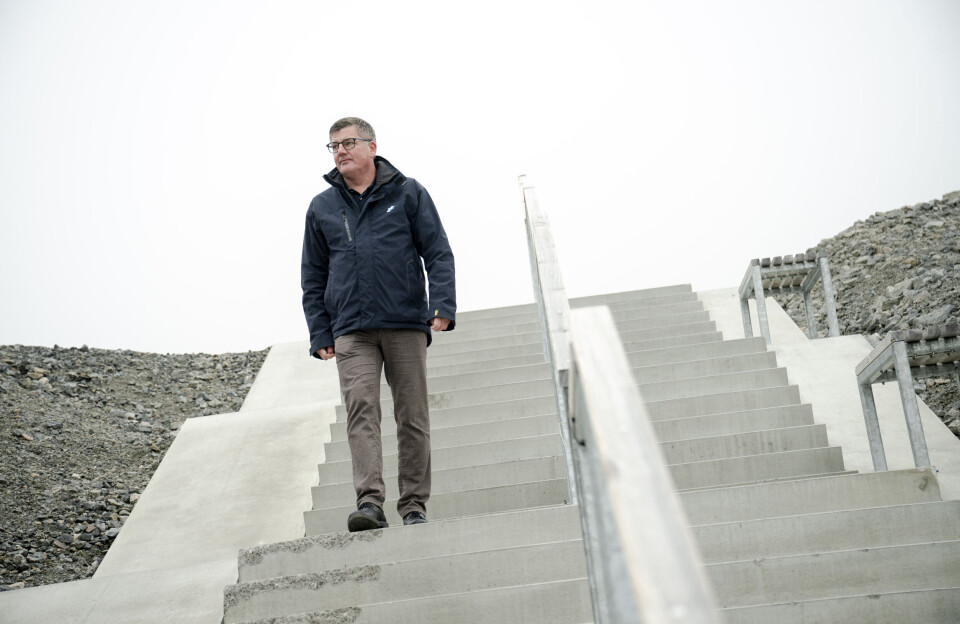
When Icelanders worked so hard, it was because it was about the survival of their nation, says Professor of History at the University of Iceland Gudmunður Hálfdánarson:
- It was an existential struggle. It was an impossible thought to give in.
The Cod Wars were about fishing territory. Iceland expanded its zone from four to 12 nautical miles in 1958. This particularly affected British fishermen, who had been catching cod in these waters for centuries to satisfy their population's craving for fish and chips.

The government in London would not recognize the new fishing limit and sent warships to protect British fishermen.
Effective harmless weapon
The dispute was settled in 1961, but in 1972 it was back on the ground. The Icelanders now extended the fishing limit from 12 to 50 nautical miles, and again the Royal Navy was sent to Iceland. This time the Icelanders used the so-called trawl scissors. A weapon that they had invented themselves. For many years a copy stood as a monument in front of the Coast Guard headquarters in Reykjavik, and it can also be seen at both the Maritime Museum and the National Museum in Reykjavik.
"We are quite proud of the trawl scissors. It was an extremely effective weapon, without it killing anyone," says Gudmunður Hálfdánarson.
Which fits well with Icelanders' self-perception as a peaceful people.
The scissors were first used during the Second Cod War. The story has become part of historical mythology: The Icelandic coastguard ship Ægir encountered a trawler fishing within the 50-nautical-mile limit, painted entirely black and without a name or number. When the Icelandic captain called out on the radio, he received a musical response: Rule, Britannia!
Ægir had a trawl cutter in tow and went astern of the unidentifiable fishing vessel – and cut a trawl wire, thereby fishing gear for a large amount of money was lost. The fishermen threw a heavy nylon rope into the water in the hope that it would go into Ægir's screw and bombard the Icelandic ship with pieces of coal, garbage and a fire axe. From the subsequent shouting on the ship's radio it could be determined that the trawler's name was Peter Scott.
Many other trawlers suffered the same fate, and there were countless clashes, literally, between the Icelandic coastguard ships and British frigates, who rammed each other. The two sides also fired grenades at each other, although without explosive charges.
No exploitation
The Third Cod War in 1975-1976 was the most violent. As an explanation for the fearless conduct of the Icelanders, Gudmunður Hálfdánarsson points out that Iceland had become independent from Denmark just a few years earlier, in 1944. So nationalism, patriotism, was part of the driving force. Foreigners should not exploit Iceland's resources.
"It was pretty clear that the stocks were being exploited too heavily," the professor says.
- So if nobody did anything, it could become impossible to live in Iceland. It is a quite barren country. That is why we have to import most of it, and that is why it is necessary to export something in return, so that there is something to pay with, says the professor.
- In the 1970s, 90 percent of exports were fish, mostly cod.
- It was a matter of national pride to protect our resources. Iceland was not willing to compromise on anything, so it was difficult to solve the problem.
The right side of history
So what can Greenland – which is also in conflict with a much larger NATO country – learn from Iceland's behavior during the Cod Wars?
- I believe that Greenland and Denmark must not give in, because then they have lost. There are only two options here: that you win or that you lose.
As for the means, the professor believes that it is important to influence opinion formation in the United States:
- Among the Americans there is no desire to take over Greenland against the will of the Greenlanders. So that is where we should start, he tells Lars Toft Rasmussen, who is also the author of the book "Logbook from the North Atlantic. A journey through the crumbling Danish empire".
When the Icelanders emerged victorious from all the cod wars, there are several reasons. One is that they were “on the right side of history,” as the professor says. Within a few years, fishing limits of 200 nautical miles had become the standard. Another factor was that it became too expensive for the British to provide naval protection for their trawlers. The expense was not commensurate with what was at stake. Another factor was that the world’s sympathy – as is now the case with Greenland – was on the Icelanders’ side. This meant that the British could not use their military superiority.
- They could have finished off the Icelandic gunboats in an hour if that's what they wanted, says Gudmunður Hálfdánarsson.
The decisive factor was perhaps Iceland's strategic location. The Americans needed the Keflavik base in particular to control the so-called GIUK gap, from which the entrance to the northernmost part of the Atlantic – with the Russian naval bases on the Kola Peninsula – can be controlled. Therefore, the USA put pressure on Britain to withdraw so as not to risk Icelandic anger spilling over to the Keflavik base.
So the strategic placement was to Iceland's advantage. Whereas in Greenland it may be the real problem.
Abonnementer
Sermitsiaq.gl - web artikler
- Adgang til alle artikler på Sermitsiaq.gl
- Pr. måned kr. 59.00
- Pr. år kr. 650.00
Sermitsiaq - E-avis
- Adgang til Sermitsiaq e-avis som udkommer hver fredag
- Adgang til alle artikler på Sermitsiaq.gl
- Pris pr. måned kr. 191
- Pris pr. år kr. 1.677
AG - Atuagagdliutit E-avis
- Adgang til AG - Atuagagdliutit e-avis som udkommer hver onsdag
- Adgang til alle artikler på Sermitsiaq.gl
- Pris pr. måned kr. 191
- Pris pr. år kr. 1.677
Sermitsiaq.AG+
- Adgang til AG - Atuagagdliutit e-avis som udkommer hver onsdag
- Adgang til Sermitsiaq e-avis som udkommer hver fredag
- Adgang til alle artikler på Sermitsiaq.gl
- Adgang til Arnanut e-magasin
- Adgang til Nutserisoq.gl
- Ved interesse send en mail til abonnement@sermitsiaq.gl
Kære Læser, Velkommen til Sermitsiaq.gl – din kilde til nyheder og kritisk journalistik fra Grønland. For at kunne fortsætte vores vigtige arbejde med at fremme den frie presse og levere dybdegående, kritisk journalistik, har vi indført betaling for udvalgte artikler. Dette tiltag hjælper os med at sikre kvaliteten af vores indhold og støtte vores dygtige journalister i deres arbejde med at bringe de vigtigste historier frem i lyset. Du kan få adgang til betalingsartiklerne fra kun kr. 59,- pr. måned. Det er nemt og enkelt at købe adgang – klik nedenfor for at komme i gang og få fuld adgang til vores eksklusive indhold. Tak for din forståelse og støtte. Dit bidrag hjælper os med at fortsætte vores mission om at levere uafhængig og kritisk journalistik til Grønland.