
A new population projection looks less negatively at the development of the Greenlandic-born part of the population towards 2050.
Previous calculations indicated a decrease of 20 percent. The new calculation expects a decrease of 14 percent - that is, six percentage points less.
Statistics Greenland emphasizes that there is great uncertainty about the calculations, especially due to the size of the population.
The Statistics Office writes that the new calculations take into account the observed behavior in recent years in relation to re-immigration to a greater extent. In addition to updated data, this is the reason for the new result.
The table below shows the development in numbers. It appears that the Greenlandic-born part of the population is expected to fall from 49,721 in 2026 to 42,923 in 2050.
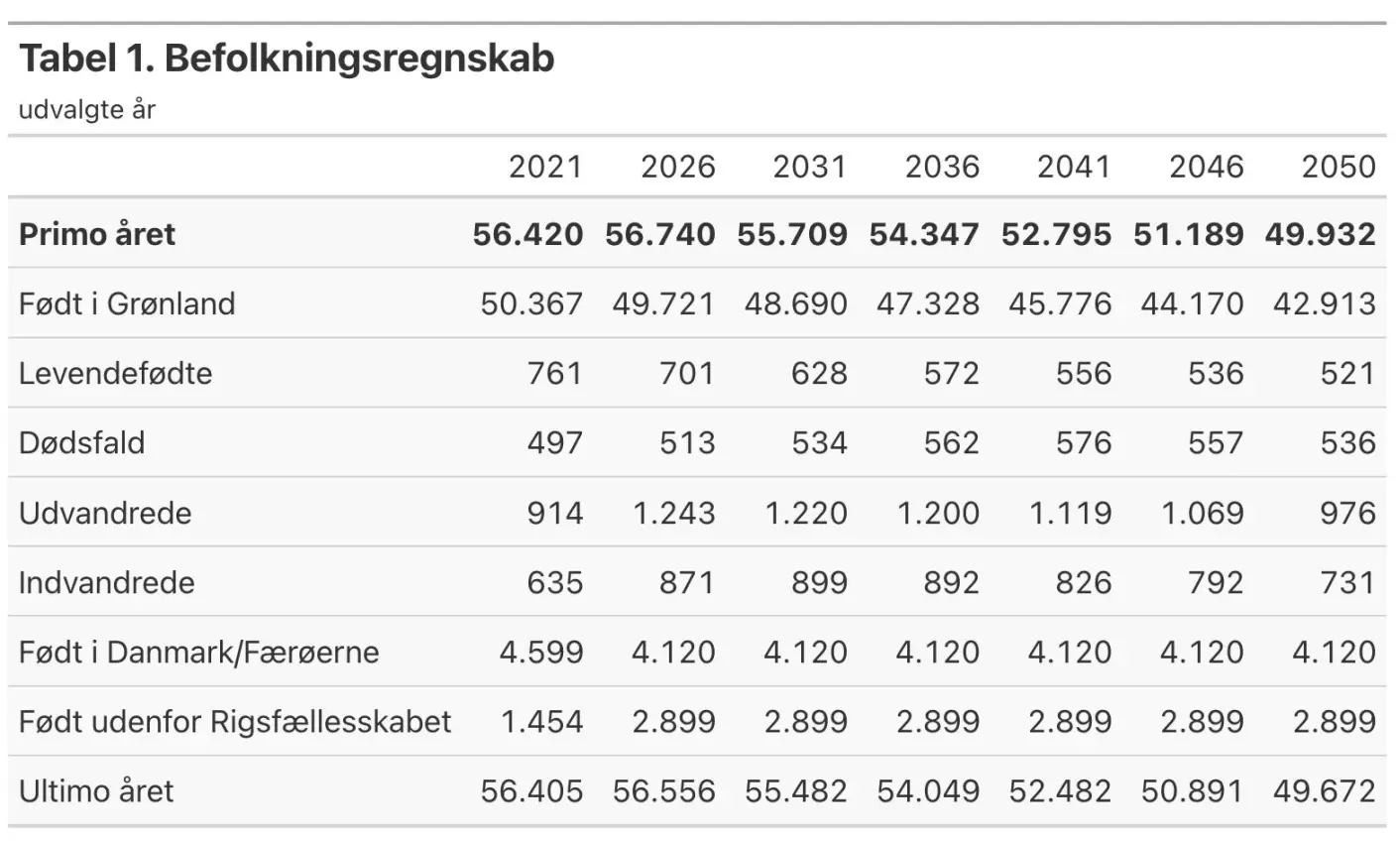
Lower fertility and emigration are expected to put pressure on the population
Statistics Greenland describes that large cohorts from the 1960s will reach ages with higher mortality in the coming years, which is expected to be lower than the mortality experienced by previous generations at the same age.
Therefore, the average age of the population is expected to increase by four years from 35.7 in 2026 to 39.7 in 2050.
The number of Greenlandic-born citizens is also expected to fall during the period due to falling fertility and relatively high emigration.
On average, 367 people emigrate annually
Statistics Greenland highlights that while 10 years ago around 800 children were born annually, in 10 years, with the current low fertility rate, it is expected that less than 600 children will be born annually.
Regarding emigration, an average of 367 people have left Greenland net (i.e. emigration minus immigration) every single year for the past 30 years.
Emigration was lowest in the pandemic year of 2020, with 167 net emigrants of Greenland-born people, writes Statistics Greenland.
Statistics Greenland points out that the model only describes the part of the population that lives and was born in Greenland. This means that the part of the population that was born outside Greenland is assumed to remain constant in the table.
The Statistics Office also makes this reservation: How many people will live in Greenland in 10, 20 or 30 years depends largely on political and economic decisions.