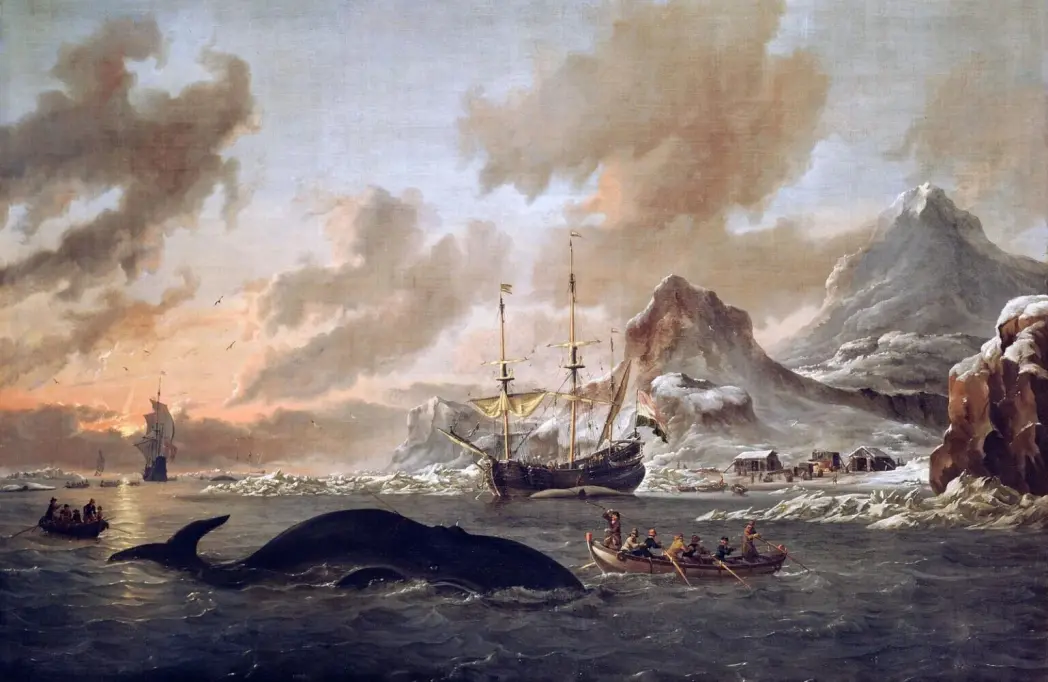
For a whaler, the bowhead whale (Balaena mysticetus) is almost the perfect prey.
The whale, which can weigh up to 100 tons, is a slow swimmer, and when it dies, it does not sink to the bottom like most other whales.
Instead, the bowhead whale's thick layer of blubber acts as a life jacket, keeping the giant afloat at the surface. It was precisely the blubber that was the primary reason for the intense harvest of bowhead whales in the past.
The fat was boiled into oil, which was an extremely expensive and sought-after commodity in large parts of the world, where it was used in particular in lamps. For the same reason, the bowhead whale was hunted so massively over a period of just over 400 years that by the 1920s there were almost none left.
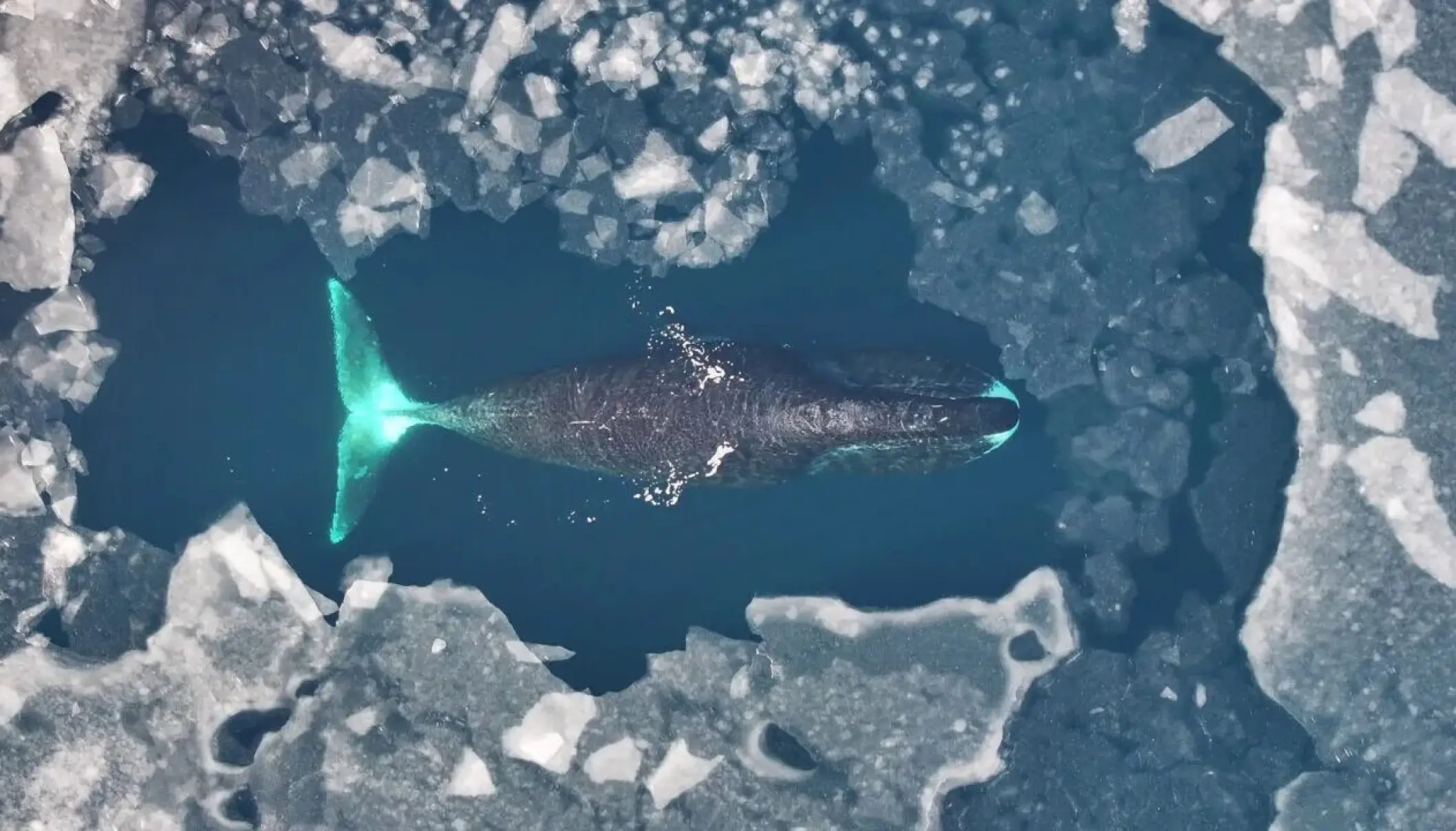
Not long after, the species was protected, and today the population is thriving, but the deadly past has left deep traces that could threaten the whale's future. This is shown by a new comprehensive study that has just been published in the scientific journal Cell.
- We describe how the bowhead whale as a species has lost a large part of its genetic diversity, and how the negative development will only continue, says Eline Lorenzen, professor of molecular natural history at the Globe Institute at the University of Copenhagen and lead author of the new study, to Videnskab.dk.
- In short, this means that the bowhead whale may become much more vulnerable to climate change, diseases and other threats in the future.
Unique time series
Despite being large, whale bones are difficult to find. The skeletons of dead whales typically end up on the seafloor, where they are eaten by fish and microorganisms. In the new study, however, the researchers have had access to a completely unique collection of prehistoric bowhead whale bones, spanning the past of the bowhead whale, but can also tell a great deal about the giants' present and future. The many bones were collected by geologists in the 1980s and 1990s and ended up with Eline Lorenzen and the other authors by chance.
- I came to a scientific conference in 2017 by chance, where I completely randomly got into conversation with a colleague who mentioned this time series of hundreds of bowhead whale bones collected in the high Arctic of Canada, says Eline Lorenzen.
- I dropped my jaw and had to get hold of them immediately!
Shortly afterwards, she heard about a similar series of bones – also from bowhead whales – collected on Svalbard in northern Norway.
- Suddenly we had two independent and comparable time series of bowhead whale history from the eastern to the western Atlantic. So, what are the chances? That's absolutely crazy! says the professor.
In the new study, the researchers have examined the bones according to all the rules of the art. Each one has been dated using the carbon-14 method, while modern isotope analyses reveal where the individual whales lived, what they ate, and what the ecosystem was like back then.
Finally, the researchers have mapped the genomes of the individual whales from fossil DNA in the bones and compared the results with the genomes of living bowhead whales.
Overall, the study tells two overarching stories:
Bowhead whales have been an extremely robust species over time, surviving dramatic climate changes over the past several thousand years.
Today's bowhead whales have greatly diminished genetic diversity compared to whales that lived before commercial whaling.
Dangerous bottleneck
So what does that mean?
- This means that human predation on these whales has had enormous consequences that will continue for thousands of years, says Eline Lorenzen.
Before the massive impact of humans, the bowhead whale could otherwise withstand most things.
- Our analyses show that over the past 11,000 years, the whales have experienced dramatic climate changes with average temperatures that were two to three degrees higher than today, says the professor.
- They have apparently managed this without major problems, because we see no significant decline in numbers, distribution or genetic diversity.
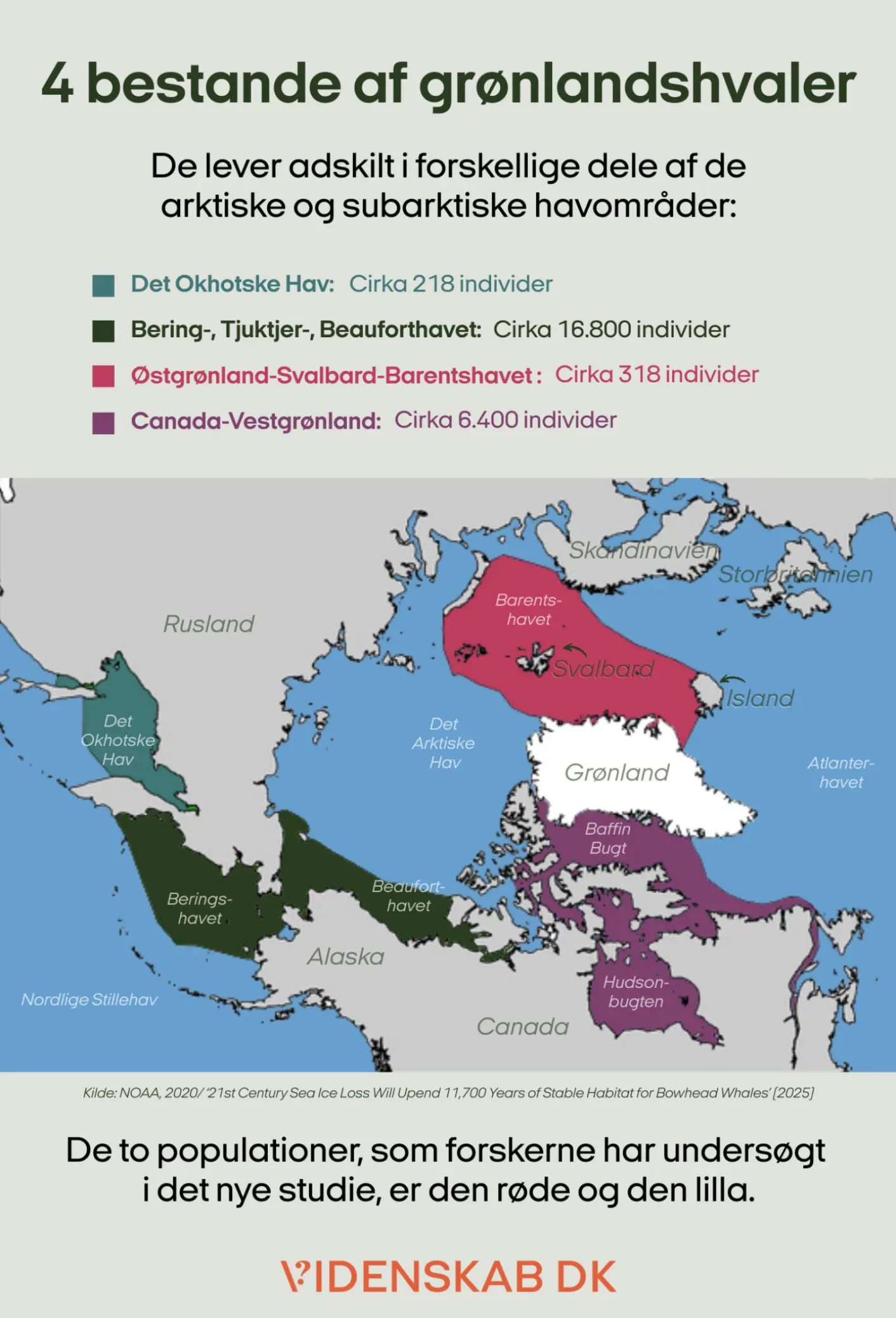
However, it came with the commercial whaling that took off from around the year 1540. Historical records based on logbooks from whaling ships testify to staggering figures. The population around Svalbard – officially known as East Greenland-Svalbard-Barents Sea – has shrunk from around 52,000 individuals to just a few hundred.
- The decline is in line with what we can read in the genetic data. It is absolutely crazy, says Eline Lorenzen.
Further west, the Canada-West Greenland population has declined from around 18,500 to 6,000 individuals.
The development has created a genetic bottleneck that could have a major negative impact on the bowhead whale.
- When the number of individuals in a population falls so drastically, the genetic diversity also shrinks significantly in just a few generations, says Eline Lorenzen.
- But that process takes many, many generations and has not yet been fully expressed because it has only been four or five generations since whaling ceased.
Genetic diversity is the total pool of genes and other DNA in the genome that a species has to draw on when it is constantly trying to adapt to changing environmental conditions, diseases or climate change. In the case of the bowhead whale, that pool has become much smaller.
- You can compare it to a Swiss Army knife: The greater the genetic variation, the more tools there are in the Swiss Army knife, says Eline Lorenzen.
- The bowhead whale today has far fewer tools in its Swiss Army knife than before.
»State of the art«
- It is an incredibly interesting study, says Michael Møller Hansen, professor at the Department of Biology at Aarhus University.
Here, he researches genetic variation and its significance for the adaptation and survival of populations and species. He is not involved in the new study, but has read it for Videnskab.dk.
- In terms of research and methodology, it is state of the art (the highest level, ed.), says the professor.
- They combine the best and most modern methods and show very convincingly that the bowhead whale has not been vulnerable to climate change and other environmental factors over the past 11,000 years. The only thing that has really mattered is whaling.
Here, however, the consequences are long-lasting.
- Bowhead whales will lose more and more genetic variation over the coming generations, simply because there are far fewer whales than before. For each generation variation will be lost until it stabilizes at a lower level, says Michael Møller Hansen.
The projections in the new study run up to the year 3500. Here, the genetic decline is far from ceasing yet.
- It takes tens of thousands of years to rebuild genetic variation, says Eline Lorenzen and points to a major potential challenge for bowhead whales.
- Historically the species has adapted to rising temperatures, but it may become more difficult in the coming decades, she says.
The majority of whales killed by whalers came from the more southern parts of the whales' habitats.

- It is probably the more southerly whales in a given population that have adapted to higher temperatures, while those furthest north have not had the same needs, says Eline Lorenzen.
- Today, the genetic material from the more southern whales has largely been lost, and this may weaken the species' ability to adapt.
Abonnementer
Sermitsiaq.gl - web artikler
- Adgang til alle artikler på Sermitsiaq.gl
- Pr. måned kr. 59.00
- Pr. år kr. 650.00
Sermitsiaq - E-avis
- Adgang til Sermitsiaq e-avis som udkommer hver fredag
- Adgang til alle artikler på Sermitsiaq.gl
- Pris pr. måned kr. 191
- Pris pr. år kr. 1.677
AG - Atuagagdliutit E-avis
- Adgang til AG - Atuagagdliutit e-avis som udkommer hver onsdag
- Adgang til alle artikler på Sermitsiaq.gl
- Pris pr. måned kr. 191
- Pris pr. år kr. 1.677
Sermitsiaq.AG+
- Adgang til AG - Atuagagdliutit e-avis som udkommer hver onsdag
- Adgang til Sermitsiaq e-avis som udkommer hver fredag
- Adgang til alle artikler på Sermitsiaq.gl
- Adgang til Arnanut e-magasin
- Adgang til Nutserisoq.gl
- Ved interesse send en mail til abonnement@sermitsiaq.gl
Kære Læser, Velkommen til Sermitsiaq.gl – din kilde til nyheder og kritisk journalistik fra Grønland. For at kunne fortsætte vores vigtige arbejde med at fremme den frie presse og levere dybdegående, kritisk journalistik, har vi indført betaling for udvalgte artikler. Dette tiltag hjælper os med at sikre kvaliteten af vores indhold og støtte vores dygtige journalister i deres arbejde med at bringe de vigtigste historier frem i lyset. Du kan få adgang til betalingsartiklerne fra kun kr. 59,- pr. måned. Det er nemt og enkelt at købe adgang – klik nedenfor for at komme i gang og få fuld adgang til vores eksklusive indhold. Tak for din forståelse og støtte. Dit bidrag hjælper os med at fortsætte vores mission om at levere uafhængig og kritisk journalistik til Grønland.