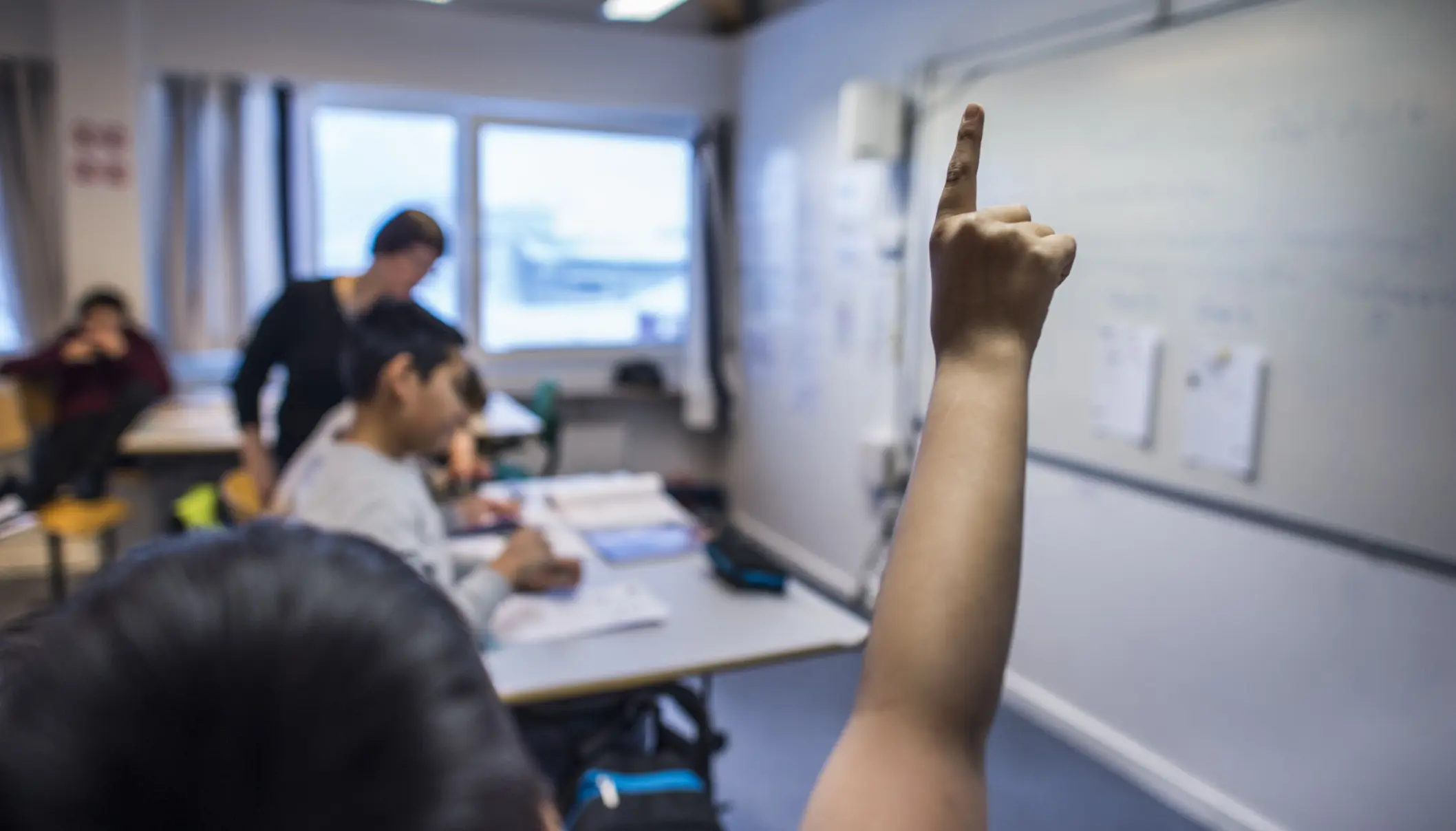
The Greenlandic Government is now prepared to implement comprehensive changes to the Primary Education Act, which the parties agreed upon when they entered into the coalition agreement.
A new structure is planned for the youngest level, while students in the 9th and 10th grades will be offered vocational courses in the form of municipal vocational classes.
- The purpose of the legislative amendment is to ensure a more holistic and practice-oriented primary school, where students achieve stronger linguistic and mathematical competences at the youngest level and at the same time offer realistic and motivating learning paths at the oldest level, according to the presentation from Naalakkersuit.
The youngest stage
Let's first focus on the youngest stage, which is changing significantly.
The number of teaching hours will be reduced from today's 700 to 560 hours spread over 180 days. Today, the 700 hours are spread over between 200 and 240 days. It is pointed out that the reduction in school days will not change for the middle and senior grades, who will continue to attend school 200 to 240 days per year.
As a consequence of fewer teaching hours, the number of school subjects will change, which will now be defined as follows:
These subjects are deleted
This means that the subject area "language" at the youngest level will in future only include Greenlandic. Thus, English and Danish are eliminated. However, it is established that Danish can continue to be offered as mother tongue teaching.
Another subject area, "culture and society", which includes the subjects social studies, history, religion and philosophy, is also being deleted.
A third subject area, "mathematics and science", is also changed to include only the subject of mathematics.
In the comments to the bill, it is emphasized that this is not a matter of downgrading English, and the decision to drop English at the youngest level "is being made as part of a strategic professional strengthening".
- The purpose is to give the students a stronger foundation in reading, writing and arithmetic as well as in Greenlandic and mathematics before the students encounter English lessons. This will also ensure that English, due to the language's ability to spread rapidly, does not outcompete Greenlandic.
Stronger identity
In connection with the creation of the new bill, the Greenlandic Government has assessed how the primary school can actively contribute to the development of a stronger Greenlandic identity, cultural understanding and cohesion in the form of so-called "nation building", which is also included in the coalition agreement.
Here, they have ended up dropping nation building as an independent subject for the following reasons:
- It is the assessment that establishing nation building as an independent subject risks becoming a formal construction without real anchoring in the students' everyday life and learning. The academic elements such as cultural history, myths, legends, art, identity, mental health and responsibility are considered to be of great relevance to the purpose of primary school, which is why these should be included in an interdisciplinary context in the subjects.
- In this way, the topics can be incorporated into a holistic context, where Greenlandic values, history, language and understanding of society are linked to the students' development of identity, self-esteem and resilience. Against this background, it is proposed that nation-building should be included and be part of the teaching in all subjects.
The goal is for the changes to be implemented by 2030.
Seniority and business classes
There has long been a desire to introduce vocationally oriented programs at the senior level (9th and 10th grades) in elementary school, where practical teaching methods replace traditional classroom teaching.
Municipalities are given the opportunity - upon application to the competent authority - to offer vocationally oriented courses in the form of vocational classes, where students are attached to a company and thus gain practical experience of working life.
- The schemes are also intended to strengthen the students' well-being and motivation, create greater variation at the senior level and build a bridge between school and the labor market. The schemes could be organized so that the students spend 1-2 days a week at a company, in a vocational training program or in a practical course arranged by the student's elementary school, the legal commentary states.
Strengthen motivation
The purpose of vocational classes is to strengthen the motivation of students who do not thrive in a traditional school setting and the aim is also to get more young people to choose a vocational education.
It is determined that the following will apply:
In order for a municipality to approve a specific vocational class scheme, the municipal council must have entered into an agreement with a vocational school or other relevant educational institution that offers vocational training. The municipality is also obliged to supervise the practical courses, regardless of whether they take place at a company or an educational institution.
The hearing deadline is set for 10 February 2026.
Abonnementer
Sermitsiaq.gl - web artikler
- Adgang til alle artikler på Sermitsiaq.gl
- Pr. måned kr. 59.00
- Pr. år kr. 650.00
Sermitsiaq - E-avis
- Adgang til Sermitsiaq e-avis som udkommer hver fredag
- Adgang til alle artikler på Sermitsiaq.gl
- Pris pr. måned kr. 191
- Pris pr. år kr. 1.677
AG - Atuagagdliutit E-avis
- Adgang til AG - Atuagagdliutit e-avis som udkommer hver onsdag
- Adgang til alle artikler på Sermitsiaq.gl
- Pris pr. måned kr. 191
- Pris pr. år kr. 1.677
Sermitsiaq.AG+
- Adgang til AG - Atuagagdliutit e-avis som udkommer hver onsdag
- Adgang til Sermitsiaq e-avis som udkommer hver fredag
- Adgang til alle artikler på Sermitsiaq.gl
- Adgang til Arnanut e-magasin
- Adgang til Nutserisoq.gl
- Ved interesse send en mail til abonnement@sermitsiaq.gl
Kære Læser, Velkommen til Sermitsiaq.gl – din kilde til nyheder og kritisk journalistik fra Grønland. For at kunne fortsætte vores vigtige arbejde med at fremme den frie presse og levere dybdegående, kritisk journalistik, har vi indført betaling for udvalgte artikler. Dette tiltag hjælper os med at sikre kvaliteten af vores indhold og støtte vores dygtige journalister i deres arbejde med at bringe de vigtigste historier frem i lyset. Du kan få adgang til betalingsartiklerne fra kun kr. 59,- pr. måned. Det er nemt og enkelt at købe adgang – klik nedenfor for at komme i gang og få fuld adgang til vores eksklusive indhold. Tak for din forståelse og støtte. Dit bidrag hjælper os med at fortsætte vores mission om at levere uafhængig og kritisk journalistik til Grønland.