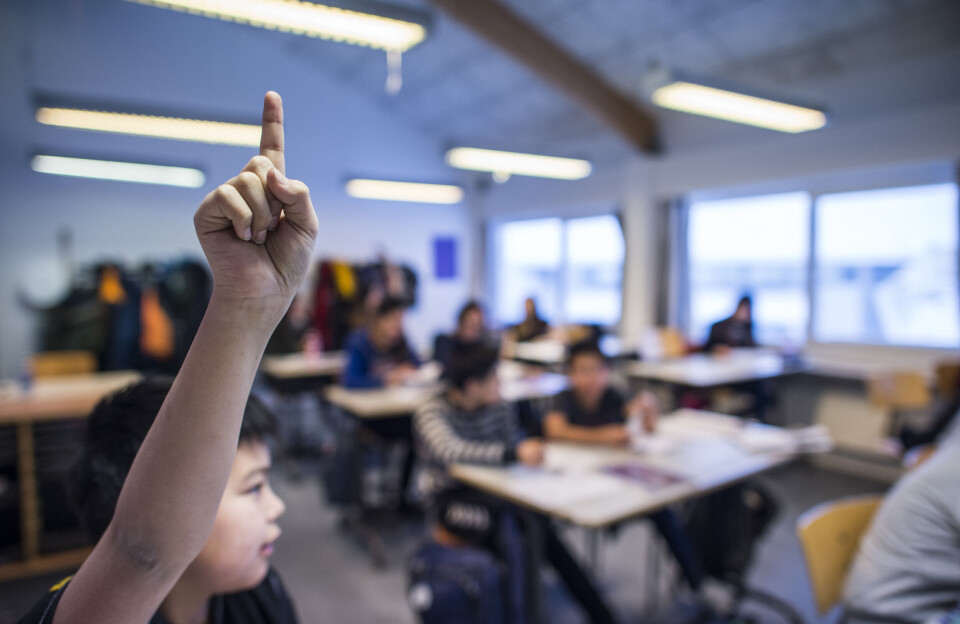
Today, students in grades 1 to 3 in primary school have too many subjects, which results in too many teaching shifts during a school day.
- This contributes to a restless and incoherent teaching. Naalakkersuisut also assesses that too many subjects can lead to too little time to delve into each individual subject, which can result in students not getting a solid foundation in relation to the most important subjects. This means the subjects that are considered to be the central cornerstones of teaching, which primarily concerns Greenlandic and mathematics, writes Naalakkersuisut in its comments on the new bill.
Many shifts inhibit basic skills
The many changes between subjects hinder students' opportunities to develop strong basic skills, it says, referring to grade tests that show that reading, writing and arithmetic in particular "are not developing optimally under the current framework".
The consequence is that in future fewer subjects will be taught, so that time is created for immersion and quality in teaching, while Greenlandic mother tongue teaching is strengthened.
- The aim is also to strengthen the students' well-being, resilience, and personal and all-round development, it says.
School pressure is reduced
With fewer and shorter school days, the youngest can have "more time for leisure activities, play and spending time with family and friends, which is essential for their well-being and social development. At the same time, the school pressure that many younger children experience in their daily lives is reduced, and a better balance is created between school and childhood".
It is emphasized that the “quality of learning” does not necessarily depend on the amount of time, but on how the time is used.
- In a situation with a general teacher shortage, fewer teaching hours can even support better planned, more focused and higher quality teaching and thus actually strengthen students' learning, believes the Government of Greenland.
The number of hours in Denmark
Compared to Denmark, there is a significant change in the number of hours for the youngest students.
The new bill proposes to reduce school hours in the youngest grades from 700 to 560. This is a significant change when compared to Danish conditions, where kindergarten children have 600 hours, 1st grade students 750 hours and 780 hours in 2nd grade.
- The higher number of hours (in Denmark, ed.) is due to the "School's time bank", which covers activities outside the subjects and thus cannot be equated with teaching in subjects according to the Greenlandic understanding, points out the Government of Greenland.
The language subjects Danish and English are being eliminated.
In the comments, the Greenland Government spends a lot of space explaining why English is being removed as a subject in the youngest grades, whereas the removal of Danish is not explained in detail.
When the parties entered into the coalition agreement after the last election, they expressed a desire to upgrade English teaching. The fact that English is being eliminated from the youngest grades is explained as follows:
- The objective in connection with the preparation of the proposal has been to ensure a real upgrade of English teaching starting from the 4th grade, after the students have been strengthened in Greenlandic on the basis of prioritized native language teaching in Greenlandic in the youngest grades.
And it is added:
- The purpose is to ensure that the students have a solid foundation in Greenlandic, both in terms of reading and writing, before starting the upgraded English lessons.
Warnings
Naalakkersuisut refers to warnings from Oqaasileriffik “about phasing in the English language as the first foreign language and phasing out the Danish language as the language of instruction and mandatory subject in primary school”.
- In this connection, Oqaasileriffik warned against a hasty introduction of English as the first foreign language without first ensuring the status of the Greenlandic language and the necessary prerequisites for qualified English teaching. Oqaasileriffik pointed out the risk that an early and unprepared prioritization of English could limit the use and strengthening of Greenlandic as a mother tongue, and that there is currently a lack of sufficient numbers of teachers, relevant teaching materials and dictionaries targeted at Greenlandic-speaking students. The overall concern concerns not least the issue of the rapid spread of the English language at the expense of Greenlandic.
The comments do not spend time explaining the consequences of removing Danish as a subject. The only explanation is that "Danish is being removed from the youngest grade in accordance with the overall objective of reducing the number of subjects while increasing the focus and prioritization of Greenlandic in the youngest grade. It should be noted that Danish can be offered as mother tongue education".
The Greenlandic identity
It has been a great desire, as stated in the coalition agreement, that the primary school should actively contribute to developing a stronger Greenlandic identity, cultural understanding and cohesion under the term "nation building".
The Greenlandic Government writes that nation-building “must be understood as a long-term process that cannot be solved with a “quick fix”, but which should be incorporated into the various subjects in primary school and across the education system and supported by society’s other institutions”.
- In this context, reference can be made to the Nunavut Education Framework, which functions as a vision and a framework for the entire education system in Nunavut. Here, the focus is precisely on integrating culture, language and values across subjects and levels rather than placing nation building as an isolated subject. In this way, it is ensured that the intentions in the coalition agreement are respected and translated into practice, while avoiding establishing a subject without the necessary professional and practical anchoring, the explanation is.
Timeframes
The consultation deadline for the new bill on primary school has been set for February 10, and the aim is to implement the changes by 2030.