“Hello Dad – it’s me,” a little girl whispers into the microphone and then stops completely.
An elderly mother sends a greeting to her son in a shaky, tearful voice. And a young girl sends a greeting that is so bold that it is right on the edge of “what could be said in public like that”.
The year is 1932 and the place is Stærekassen, the Danish State Radio's studios at the Royal Theatre in Copenhagen. The radio has just launched a new concept that will prove to be a brilliant idea. The broadcast is called "Christmas Greetings to Greenland", and it was to have a lifespan of 91 years before, as you know, it was closed down last year.
One of the best ideas
The fact that ordinary people could have access to the radio medium was something completely new and groundbreaking, and therefore the newspapers – such as Social-Demokraten and Frederikborg Amts Avis, from which the above quotes originate – covered the first broadcasts in detail. Over the course of three evenings/nights, people could turn up at the radio studio and record their greetings to their loved ones who were in Greenland. Frederiksborg Amts Avis called the broadcast “one of the best ideas that the State Radio has realized in a long time”.
The program was broadcast live over the shortwave masts across the Atlantic via Reykjavik. It began with solemn speeches from, among others, Prime Minister Stauning and was spiced up with live music. In Denmark, the whole thing took place in the orchestra studio in Stærekassen from 11 p.m., where it was broadcast live for three consecutive nights. If you could not attend in person, you could fill out a form in advance with your greeting, which was read out by the radio station's speakers.
The program was such a success that the following year it was expanded to include broadcast days from studios in Aalborg, Randers, Aarhus, Esbjerg, Aabenraa, Odense and Nykøbing Falster, and later also Skive and Rønne. It could be difficult to hear the weak radio signal in some of the Greenlandic towns, but it helped when Iceland Radiofoni stepped in and set up its own broadcasts to help pass on the greetings.
In addition to the novelty of ordinary people being able to access the radio, it was also unusual that during the Christmas greeting broadcasts you could hear the Greenlandic language spoken on the radio. Both when Greenlanders who were staying in Denmark sent greetings home, but also when some of the official speeches were translated into Greenlandic, which was done by Captain Johannes Balle, who had grown up in Greenland as the son of seminary principal N.E. Balle and spoke the language fluently.
Greenlanders in Denmark
The group of Greenlanders in Copenhagen in the 1930s was growing. From the mid-19th century, the Danish authorities began sending young Greenlanders on educational stays in Denmark – at first with great reluctance, but gradually more and more were sent because the KGH needed more assistants and craftsmen who could speak both Danish and Greenlandic. In the period 1927-1936, for example, 41 young Greenlandic men were sent to Denmark to be trained as carpenters and coopers. While in Denmark, they lived at the Greenlandic Home in Kastrup, which had opened in 1928. A few specially selected women came to Denmark to be trained as midwives – a practice that had started in 1835. And a newly founded committee, the Committee for the Education of Greenlandic Women, sent young women on two-year training stays in Denmark from 1925 to learn about housekeeping and childcare. At the same time, it was possible for Danish civil servant families who had stayed in Greenland to take their Greenlandic kiffaq with them to Denmark when they returned home. Gradually, the group of Greenlanders in Denmark grew. The young Greenlanders in Copenhagen often met on Sundays at the Greenlandic Home, and in 1939 they founded the Greenlandic association Peqatigiit Kalaallit as a gathering place and discussion forum.

The small but close-knit Greenlandic community in Denmark came to influence Radiofonien's new program. The original idea for the program was that "Parents and Relatives in Denmark" should send Christmas greetings to their "relatives" in Greenland, as the Danish business leader Andreas Lund Drosvad, who worked for KGH in Kangersuatsiaq near Upernavik, suggested in a letter to Radiofonien in the summer of 1932. But already from the first broadcast, Greenlanders who were in Denmark also began to appear in Stærekassen to record Christmas greetings to their family and friends in Greenland. The program thus became the framework for a cultural meeting between Greenlanders and Danes, which was relatively rare at that time.
The radio seems to have supported this development of the program. Personal greetings were preferred, and lengthy written greetings from Danish institutions that worked with Greenland, for example the aforementioned Committee for the Education of Young Greenlanders, were rejected.
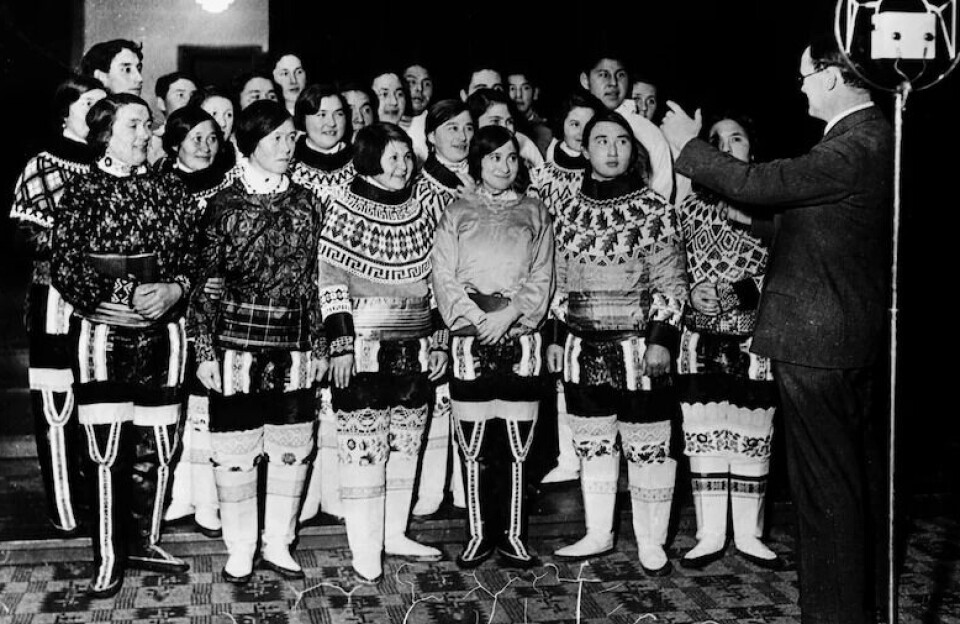
The choice of music for the broadcast was also influenced by the Greenlanders' entry into the radio studio. In 1932, the radio orchestra provided the music and played a fantasy of Danish national songs, but the following year and for many years to come, a Greenlandic choir, which had been formed in 1932 in connection with a large Greenland exhibition, sang. The choir sang, among other things, Guuterput Qutsinnermiu, which has been a regular part of the Christmas Greetings program ever since.
Politics between the lines
Another thing that characterized the Christmas Greetings in the first year was the ongoing conflict between Norway and Denmark over the right to East Greenland. In 1931, Norwegian fur trappers had raised the Norwegian flag at their Myggbukta trapping station in East Greenland, and on July 10, 1931, the Norwegian government issued a declaration that the area was now Norwegian territory, which they named Eirik Raudes Land after the Norwegian Viking Erik the Red, who had settled in Greenland many years earlier. The Norwegians claimed that the area in northeastern Greenland was a no-man's land, to which Denmark therefore had no claim.
The Norwegian attempt to annex parts of Greenland occupied both minds and space in Denmark in the 1930s. The sovereignty dispute was brought before the Permanent Court of International Justice in The Hague, and the judgment – which gave Denmark full sovereignty over Greenland – was handed down on 5 April 1933.
But when the Christmas greetings to Greenland were first brought, the showdown was still in full swing. One of Denmark's responses to Norway was to intensify their activities in East Greenland - including expeditions, scientific studies and the construction of a seismological measuring station. This political climate is reflected in several places in the Christmas greetings of the first year, where small suppositories were sent to the Norwegians, as the then landowner Uttental, according to the newspaper Social-Demokraten, sent a thank you to the Greenlanders in the colony of Scoresbysund for their application to the court in The Hague, or when director Jennow, according to Aftenbladet, greeted the bear hunters in East Greenland and wished them a good catch, adding: "And may you still be able to work under our old flag." The chairman of the Greenland Committee of the Riksdag, the conservative Pürschel, according to Berlingske Tidende, thanked the Greenlanders for the friendly reception the Riksdag delegation had received during their visit to Greenland, and wished that “our beautiful, old flag will continue, as it has for centuries, to fly high and free and proud over an undivided Greenland”. References to the case in The Hague also crept into the journalists’ formulations of the radio broadcast:
“Family after family passed by, greeting after greeting flew through the airwaves and showed that the ties that bind Greenland to Denmark are thousands. Actually, the Court in The Hague should have attended this broadcast, then it would not have been in doubt that Greenland is Danish”, wrote Social-Demokraten about the broadcast in 1932.
In a column, the editor of the Danish newspaper Aftensbladet, Carl Rasmussen, under the pseudonym Jens Hammer, lashed out at the Norwegians. He quoted the Norwegian lawyer in The Hague as criticizing Denmark for keeping the Greenlanders in a “Stone Age” state, but he wondered if the Norwegians had become very angry when they heard the Christmas greetings to Greenland, he speculated:
“The mountain dwellers jumped up when they heard Stauning’s words in the speakers… Their fists clenched. Their beards trembled. Their eyes flashed under their huge Nordic brows. Yes, and the speakers were slammed to the floor and they walked in circles between the stumps, while they screamed and, regardless of the fact that Christmas is almost here and one should therefore not use oaths, they swore until it rang out – That’s a lie. That’s a damn lie, the Danish Prime Minister is saying. Every word is a lie. The Greenlanders have no spiritual life and no culture. They are standing on the Stone Age step that the Danes have deliberately kept them down on.”
When the Christmas Greetings was broadcast the following year, Christmas 1933, the matter in The Hague had been settled, and the political climate was primarily about achieving and re-establishing peace and cooperation in the Nordic countries. Yet, in Prime Minister Stauning's speech on the first evening of the broadcast in 1933, one can trace between the lines a sense of relief that all of Greenland ended up in Danish hands:
“We are happy to know that the people who lived for hundreds of years under Danish rule feel satisfied with this coexistence, and wish to continue the development that has so far represented a series of progress in the life of the Greenlandic population, in its spiritual life and culture. There is still a will to protect and cherish the brotherly people of Greenland, and therefore all good wishes are sent on this occasion. We send greetings to the people whom it will be Denmark's honor to bring forward in the ranks of Nordic cultural peoples.”
End of Christmas greetings
Over the years, Julehilsen has been a beloved program, a regular component of many Greenlandic and Danish families' Christmas. From 1983, it was broadcast as a TV program instead of a radio broadcast – in later years, either from DR's concert hall or Musikkens Hus in Aalborg.

And the program has in its own way reflected the political developments in the Kingdom, for example by making singer Julie Berthelsen a bilingual host from 2000 or by broadcasting the program from Greenland in 2014.
It caused an outcry in Greenland when DR announced in October last year that Julehilsen had been broadcast for the last time. But DR insisted that the program had run out of time:
- The program was created for a different time, when Danes and Greenlanders were not as connected and had the technological opportunities to establish contact with each other as they do today, was the justification from DR's editorial director Gustav Lützhøft.
Greenland Radio, KNR, also did not want to take over the Christmas broadcast, although several people suggested it. KNR's director Annga Lynge denied last Christmas to KNR.gl that the station could produce a similar program, although several viewers had approached them with this request. However, the station has its own Christmas greeting, which it continues to do.
Abonnementer
Sermitsiaq.gl - web artikler
- Adgang til alle artikler på Sermitsiaq.gl
- Pr. måned kr. 59.00
- Pr. år kr. 650.00
Sermitsiaq - E-avis
- Adgang til Sermitsiaq e-avis som udkommer hver fredag
- Adgang til alle artikler på Sermitsiaq.gl
- Pris pr. måned kr. 191
- Pris pr. år kr. 1.677
AG - Atuagagdliutit E-avis
- Adgang til AG - Atuagagdliutit e-avis som udkommer hver onsdag
- Adgang til alle artikler på Sermitsiaq.gl
- Pris pr. måned kr. 191
- Pris pr. år kr. 1.677
Sermitsiaq.AG+
- Adgang til AG - Atuagagdliutit e-avis som udkommer hver onsdag
- Adgang til Sermitsiaq e-avis som udkommer hver fredag
- Adgang til alle artikler på Sermitsiaq.gl
- Adgang til Arnanut e-magasin
- Adgang til Nutserisoq.gl
- Ved interesse send en mail til abonnement@sermitsiaq.gl
Kære Læser, Velkommen til Sermitsiaq.gl – din kilde til nyheder og kritisk journalistik fra Grønland. For at kunne fortsætte vores vigtige arbejde med at fremme den frie presse og levere dybdegående, kritisk journalistik, har vi indført betaling for udvalgte artikler. Dette tiltag hjælper os med at sikre kvaliteten af vores indhold og støtte vores dygtige journalister i deres arbejde med at bringe de vigtigste historier frem i lyset. Du kan få adgang til betalingsartiklerne fra kun kr. 59,- pr. måned. Det er nemt og enkelt at købe adgang – klik nedenfor for at komme i gang og få fuld adgang til vores eksklusive indhold. Tak for din forståelse og støtte. Dit bidrag hjælper os med at fortsætte vores mission om at levere uafhængig og kritisk journalistik til Grønland.