The fog lies low over Lemvig Harbor this afternoon, like a soft veil between land and water.
Inside the Museum of Religious Art, a different landscape unfolds:
Greenlandic drum dancers in bluish shadows, pastel-colored mountains, tales from a people who know both the rhythm of the sea and the storms of the mind.
In the middle of it all hangs a small figurative work, where a man falls to the ground from his kayak — The old bachelor who wanted to fly by imitating the women's magic song, but forgot the words and fell.
Hans Lynge often used this myth as a warning: You shouldn't blindly copy others. You can be inspired, yes, but without losing yourself. That was true in his time — and it's perhaps even more true today.

That is why the exhibition “Hans Lynge – Passion is needed” awakens something in the audience: a feeling that Lynge's art not only tells about Greenland, but about cultural self-respect, responsibility and identity.
Beware of copies of "The Old Bachelor"
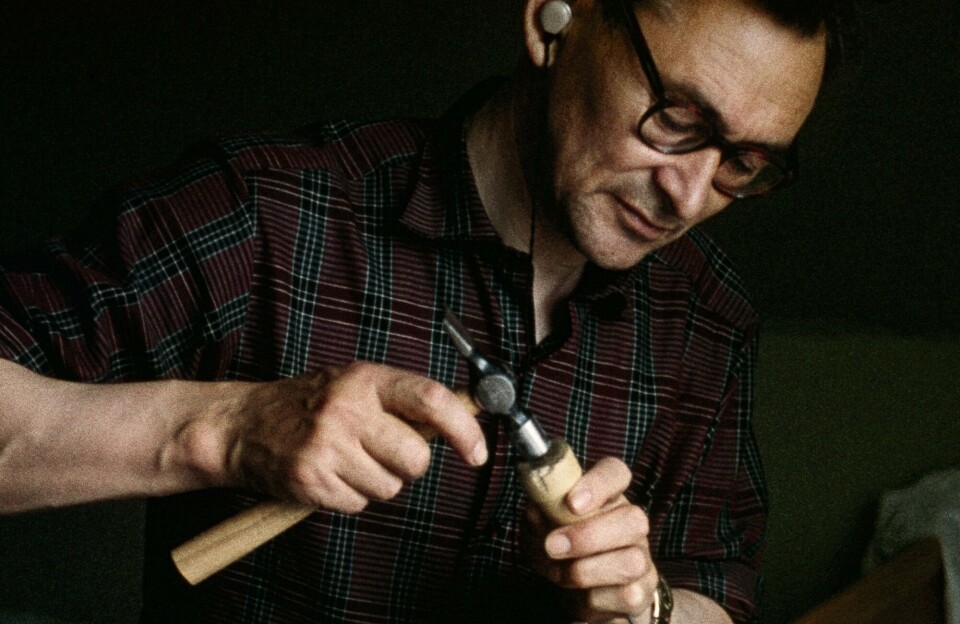
- Hans Lynge is a completely unusual figure, says Christine Løventoft-Naur, director of the Museum of Religious Art and former director of Sisimiut and Kangerlussuaq Museum, and continues:
- He was a visual artist, writer, playwright and politician – and he used all these voices to understand and influence his contemporaries. That is precisely what makes him so modern today.
According to the museum director, he worked interdisciplinary long before the word existed in our language.
- He saw no boundaries between art, society and identity, and he used his creativity as a tool to create change. It is a way of thinking that we very much recognize in our own time.

Løventoft-Naur emphasizes that Lynge grew up in a time when Greenlandic culture was under pressure. It was a period when Danish norms and institutions set the agenda, and when many traditional practices – from drum dancing to storytelling – were either discouraged, marginalized or banned altogether. The Greenlandic language was increasingly suppressed in schools, and the Inuit way of life was often seen as something to be moved away from in order to become “modern”. It was in this cross-pressure between assimilation and cultural pride that Lynge shaped his identity – which would later shape both his art and his political voice.
At home he spoke Greenlandic, and later at the seminary he learned Danish, and it was precisely this dual linguistic background that shaped him.
- He had a nuanced view, especially on the relationship between Danes and Greenlanders, she says, elaborating:

- He criticized the inequality and the Danishization of Greenlandic society, but he was not against Danish culture. He was against unconscious imitation.
Here she refers again to the old myth, The Old Bachelor, the cover of the exhibition catalogue.
- That's exactly what the myth is about: You can't believe that you can fly just because you copy the song. You have to know your own culture — that's the foundation. But you can also be inspired. It's a very modern idea.
Heather gave the myths status
When Lynge began depicting Greenlandic myths and legends in the 1960s, it was far from common. Drum dancing was condemned. Inuit culture was marginalized. Yet he insisted on giving it space.
- He elevated the myths into a modern visual art, explains Løventoft-Naur.
- It was a form of cultural rebirth. A bit like Romanticism and Grundtvig in Denmark: You look back to understand what you have been through.

The figurative idiom — which was once considered old-fashioned in the artistic world — became a conscious choice for Lynge. He painted everything from blue-toned landscapes to legendary figures with an almost French neo-impressionist inspiration, drawn from his study trip to Paris. The colors vibrate, and the calm of the motifs conceals a strong vision of society.
Criticism of colonial rule was new
The art history-trained museum director talks about one of Lynge's plays, "Christmas Bustle", where he criticizes both Danish traders and individual Greenlanders.
- Hans Lynge took action in both places, she states and elaborates:
- He criticized the colonial government — but also social problems in Greenlandic society, such as alcoholism. That was very brave in the 1930s. The colonial government was not used to criticism, and it had consequences for him. He was dismissed as an interpreter.
Yet his sharp, nuanced voice made him popular and led him into the South Greenland Provincial Council, where he spoke for education, cultural self-respect and responsibility.
- He said: ‘We must be able to support ourselves.’ Not in isolation, but by building on our own roots — and again: not to hold on to the past, but to understand it, she says.

In the catalogue you will find a quote that frames his view of man and society:
“You have to learn from your own mistakes.” Implied: If you make a mistake, you have to fix it yourself. You shouldn’t make others do it.
- Fundamentally, he believed that the future is built on responsibility, education, and honest knowledge of the past. Not on nostalgia, but on self-insight.
Although Hans Lynge died in 1988 and was positive towards the Danish Commonwealth in his time, according to the museum director, she emphasizes that he cannot be directly drawn into today's independence debate for that reason. She says:
- That would be abusing him. I spoke to his widow, Inge Lynge, and she mentioned, among other things, that no one can say where he would stand today. But we know where he stood then — and there he was both brave, nuanced, and clear.
Yet she experiences a strong topicality in his work. According to her, there was something incredibly fresh about his voice. Finally, she sums up his artistic personality:
- He was sharp, but never shrill. Critical, but never simplistic. It's a tone that all societies could use more of today.
Abonnementer
Sermitsiaq.gl - web artikler
- Adgang til alle artikler på Sermitsiaq.gl
- Pr. måned kr. 59.00
- Pr. år kr. 650.00
Sermitsiaq - E-avis
- Adgang til Sermitsiaq e-avis som udkommer hver fredag
- Adgang til alle artikler på Sermitsiaq.gl
- Pris pr. måned kr. 191
- Pris pr. år kr. 1.677
AG - Atuagagdliutit E-avis
- Adgang til AG - Atuagagdliutit e-avis som udkommer hver onsdag
- Adgang til alle artikler på Sermitsiaq.gl
- Pris pr. måned kr. 191
- Pris pr. år kr. 1.677
Sermitsiaq.AG+
- Adgang til AG - Atuagagdliutit e-avis som udkommer hver onsdag
- Adgang til Sermitsiaq e-avis som udkommer hver fredag
- Adgang til alle artikler på Sermitsiaq.gl
- Adgang til Arnanut e-magasin
- Adgang til Nutserisoq.gl
- Ved interesse send en mail til abonnement@sermitsiaq.gl
Kære Læser, Velkommen til Sermitsiaq.gl – din kilde til nyheder og kritisk journalistik fra Grønland. For at kunne fortsætte vores vigtige arbejde med at fremme den frie presse og levere dybdegående, kritisk journalistik, har vi indført betaling for udvalgte artikler. Dette tiltag hjælper os med at sikre kvaliteten af vores indhold og støtte vores dygtige journalister i deres arbejde med at bringe de vigtigste historier frem i lyset. Du kan få adgang til betalingsartiklerne fra kun kr. 59,- pr. måned. Det er nemt og enkelt at købe adgang – klik nedenfor for at komme i gang og få fuld adgang til vores eksklusive indhold. Tak for din forståelse og støtte. Dit bidrag hjælper os med at fortsætte vores mission om at levere uafhængig og kritisk journalistik til Grønland.