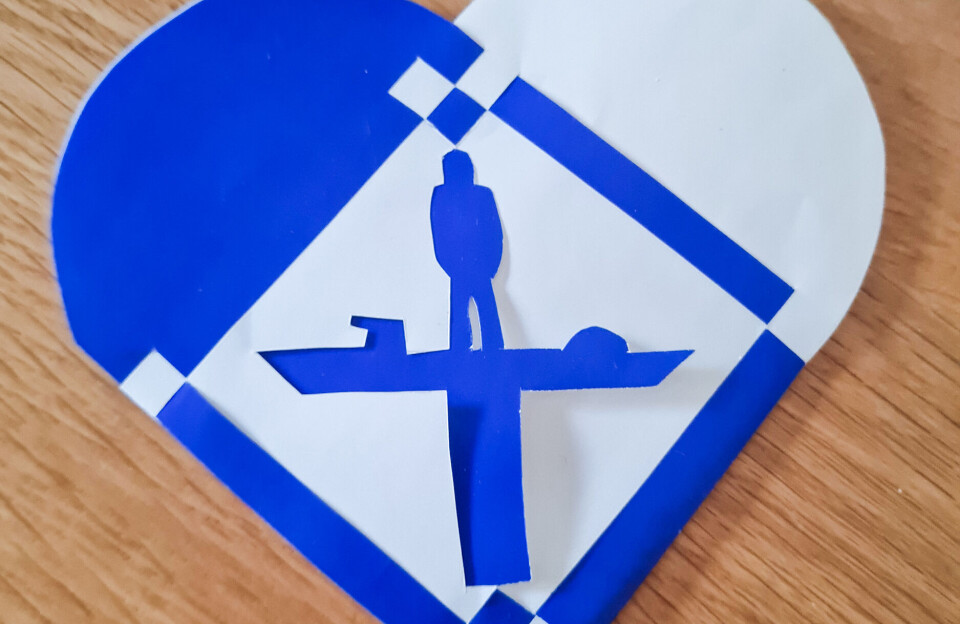

Two pieces of paper in different colors that are folded, drawn and cut, and then the two halves are intertwined by alternately passing the strips in and out of each other.
It shouldn't be difficult. Like at all. That's why I'm not particularly proud to admit that I'm one of those who has very rarely had the luck of making a nice braided Christmas heart out of paper. That means I haven't ventured into this crafty activity for several years. Not even with the kids. I make other things. Something easier. Like garlands or mousetraps.
In this newspaper, however, we have two extraordinarily beautiful recipes for braided Christmas hearts that are worth trying.
The Christmas heart with the flag was made by Aviaja Kleist Burkal, while Martine Lind Krebs, who is currently working on the book “Monumentet” from Gads Forlag together with senior researcher Astrid Nonbo Andersen from DIIS, was responsible for the kayaker.
- The book is about the Greenland Monument on Christianshavn's Square, and it inspired me for the Christmas heart, says Martine Lind Krebs to AG.
According to Wikipedia, the braided Christmas heart has its origins in the Scandinavian and Central European paper craft tradition, and the first known instructions on how to braid a two-striped Christmas heart were published in the magazine Nordisk Husflidstidende in 1871.
The oldest known Christmas heart dates from the mid-1800s and was cut by the author H.C. Andersen. Other sites, however, point out that there are other Christmas hearts from before H.C. Andersen and AG has not been able to verify which of the statements is correct. But it can be safely concluded that braided paper Christmas hearts are more than 100 years old.
This small paper object, the Christmas heart, is a testament to how a simple idea over time became a powerful symbol of creativity, care and Christmas cheer in the Nordic countries. The tradition spread slowly and only became common in Danish homes around the beginning of the 20th century. It has not been possible to find a date for when the first Christmas hearts were woven in Greenland. But an important reason why they became so popular is supposedly due to the German educator Friedrich Fröbel, who suggested it to strengthen children's imagination, fine motor skills and discipline through needlework. And so the weaving of Christmas hearts became a regular feature of December activities for children.