
Spring 2025.
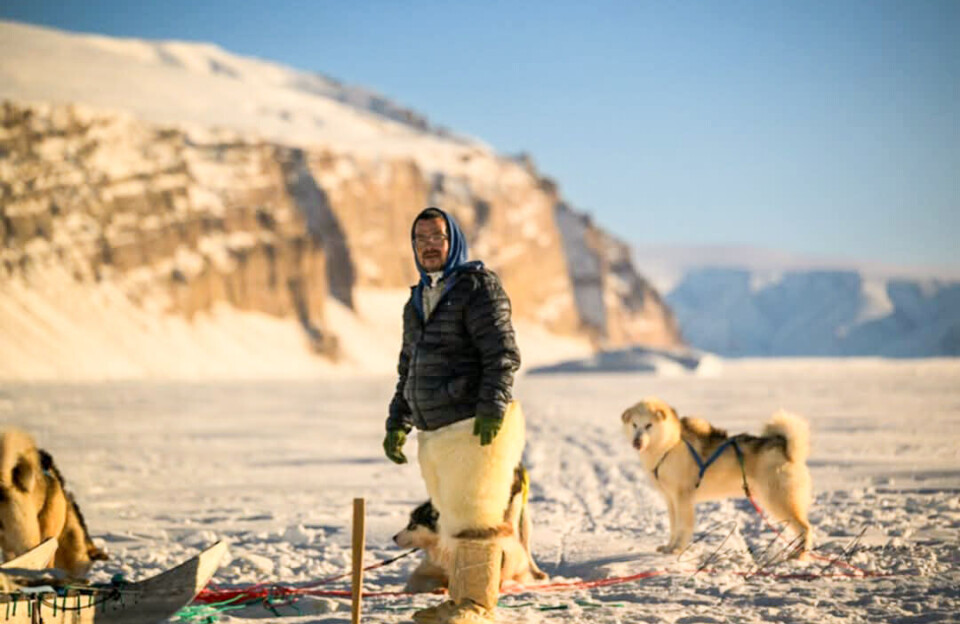
The Kristensen family is on their way out with the dog sleds. They are driving in several sleds, and Olennguaq Kristensen's son follows in his own. The goal is clear: They are going to catch kingfishers.
Spring 2025.
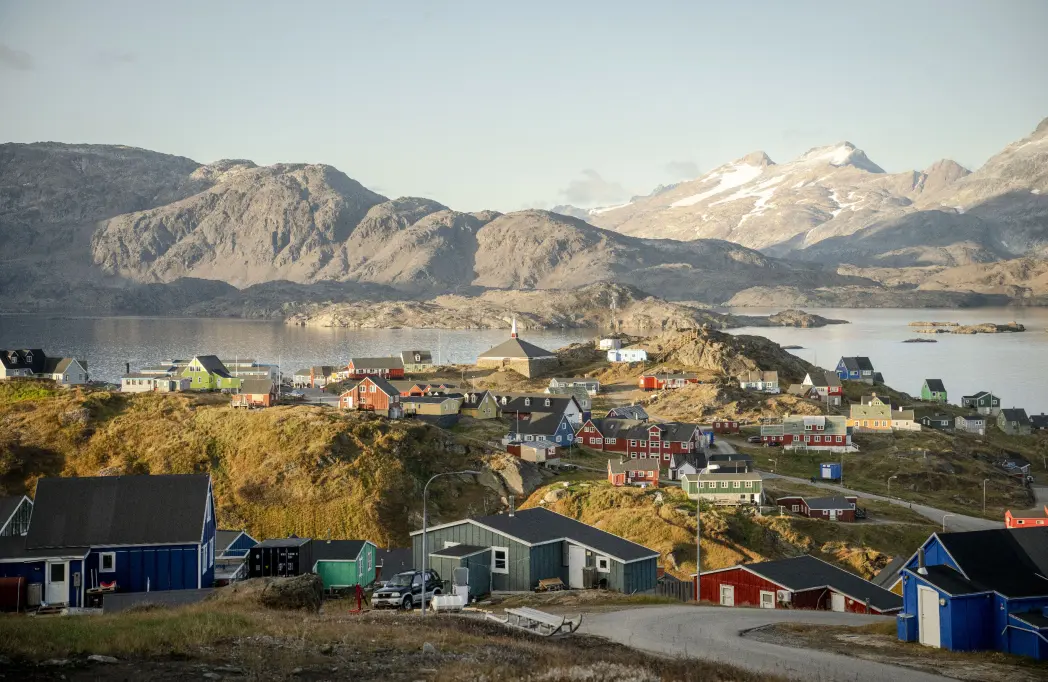
We are in Savissivik – the place where the ice rules.
The village, which is spelled Havighivik by its inhabitants – who numbered 48 at the start of the year – is located south of Qaanaaq in the northwestern part of Melville Bay.
Olennguaq is riding with his wife, Naduk, and the couple's grandson. In the sled are several long bamboo poles. At the end of each pole, Olennguaq has made a net himself - this is where the kingfishers are to be caught. It is important that the birds do not get open wounds, as they would if they were shot with a rifle, because kingfishers taste better when they have not bled.

When Olennguaq Kristensen catches a kingfisher, he holds it by the wings so it doesn't fly away. With precision, he presses on the chest until the heart detaches. This is the traditional way of catching kingfishers in Avanersuaq. A method that has been passed down through generations. Olennguaq didn't grow up with the method, but it is something he learned in Savissivik.
Several sea kings richer, the family retreats, and decides to look for polar bears.
They spot polar bear tracks. There must be one nearby, Olennguaq thinks.
"Let's go up there and check Facebook and see if anyone has seen it," says Olennguaq.
But the signal was too weak. So his wife calls their daughter to see if someone has shot a polar bear. No - no news.
The heart starts beating a little faster and they follow the tracks. After only five minutes they catch sight of the bear, which has already started to flee. Olennguaq acts quickly: he cuts some of the ropes on the dog sled so that the dogs can run after the bear and hold it back.
When the dogs make the animal stand still, they attack themselves to kill it. This is how it is done in Savissivik, a method that has been used for generations, where humans and dogs work together to survive in the harsh nature.
Watch the video where the Kristensen family is on a polar bear hunt.
Father as a teacher
Olennguaq Kristensen, originally from Nuussuaq in the Upernavik area, has lived in Savissivik for 30 years. He moved to the settlement in 1995, where his wife is from.
- I have always been a trapper, except for the four years I worked as a homeroom teacher at the school. But when there were no longer enough students, I went back to trapping, he says.
After his confirmation, he followed in his father's footsteps. He was a trapper. Ever since, Olennguaq has been engaged in trapping. But the trapping methods have changed over the years.
Now, for example, he is trying to catch seals with nets.
- We can no longer rely on the sea ice. That's why I'm now setting nets east of the settlement, where there's still some sea ice. We'll have to go ashore first before we reach some ice where the net can be set, he says.

The unpredictability of the sea has become one of the biggest challenges of life as a prisoner in Savissivik.
- The sea ice is three months late. Therefore, our fishing trips during the dark period are now affected by the unstable sea ice that is no longer solid. It is dangerous to try to go further out when it is so dark. It helps when the light starts to return, he says.
Today it is lightest around two or three in the afternoon. Here you can see icebergs off the coast.
- But we can't see seals, for example, it's too dark. We use flashlights a lot. When we go dog sledding, it's safe enough because the dogs know where they're going, even when it's very dark, he says.
Stock all year round
Olennguaq Kristensen follows the hunting seasons and collects for supplies. Spring and summer are narwhal seasons.
- We pack the meat in portions so that it can be used during the winter. In the summer we dry the meat, says Olennguaq Kristensen.
- When I have caught a beluga whale in the fall, I put it in a box that I use specifically to freeze it raw with blubber and meat, he says.

Something Olennguaq Kristensen tries to do every year is to ferment kingfishers. It is called ‘kiviaq’, which is a traditional food in North Greenland. The birds are wrapped in a seal, sewn together and sealed with seal fat before being buried in a stone coffin for several months to ferment.
- We do the same with walrus meat, and then it has to lie underground for a long time, covered with stones, but at the same time there must be air circulation, says Olennguaq Kristensen.
Kills narwhal in kayak
Of the large animals, Olennguaq Kristensen's favorite catch is the narwhal.
- I would rather catch narwhals from my kayak. But we take the boat to the place with the whales. We use the elders' knowledge of their movements, he says.
They sail out in the dinghy and wait patiently for the narwhals with the engine turned off. When the animals come into sight, Olennguaq gets in his kayak and quietly and purposefully rows towards them.
"Ever since I learned to go narwhaling by kayak, it's been my preferred method," he says.
From his kayak, Olennguaq uses a sure hand and a capture bladder to ensure that the narwhal is taken down without the risk of it sinking.
He makes the prison bladder himself.
- I usually make the bladder the old-fashioned way with the seal's skin. I try as much as possible to make a bladder right after I have caught a seal and the fur is intact. I only remove hair and blubber from the neck area, says Olennguaq Kristensen.

That way, he not only saves money, but it's also more efficient.
He makes sure to pass on all of the skills and knowledge that Olennguaq has to all of his seven children.
- They all participate. I make sure my sons have their own boat. That way we ensure a bigger catch. For example, when we are hunting narwhals, I harpoon first, and then one of my sons is allowed to harpoon it again from their kayak, he says.
Olennguaq and Naduk have eight grandchildren – all boys.
This is how Olennguaq Kristensen lives his life in Havighivik, closely connected to both family and nature. The knowledge and skills he has learned from his elders, he carefully passes on to his children and grandchildren, so that the traditions and experiences from generations are not lost.
Abonnementer
Sermitsiaq.gl - web artikler
- Adgang til alle artikler på Sermitsiaq.gl
- Pr. måned kr. 59.00
- Pr. år kr. 650.00
Sermitsiaq - E-avis
- Adgang til Sermitsiaq e-avis som udkommer hver fredag
- Adgang til alle artikler på Sermitsiaq.gl
- Pris pr. måned kr. 191
- Pris pr. år kr. 1.677
AG - Atuagagdliutit E-avis
- Adgang til AG - Atuagagdliutit e-avis som udkommer hver onsdag
- Adgang til alle artikler på Sermitsiaq.gl
- Pris pr. måned kr. 191
- Pris pr. år kr. 1.677
Sermitsiaq.AG+
- Adgang til AG - Atuagagdliutit e-avis som udkommer hver onsdag
- Adgang til Sermitsiaq e-avis som udkommer hver fredag
- Adgang til alle artikler på Sermitsiaq.gl
- Adgang til Arnanut e-magasin
- Adgang til Nutserisoq.gl
- Ved interesse send en mail til abonnement@sermitsiaq.gl
Kære Læser, Velkommen til Sermitsiaq.gl – din kilde til nyheder og kritisk journalistik fra Grønland. For at kunne fortsætte vores vigtige arbejde med at fremme den frie presse og levere dybdegående, kritisk journalistik, har vi indført betaling for udvalgte artikler. Dette tiltag hjælper os med at sikre kvaliteten af vores indhold og støtte vores dygtige journalister i deres arbejde med at bringe de vigtigste historier frem i lyset. Du kan få adgang til betalingsartiklerne fra kun kr. 59,- pr. måned. Det er nemt og enkelt at købe adgang – klik nedenfor for at komme i gang og få fuld adgang til vores eksklusive indhold. Tak for din forståelse og støtte. Dit bidrag hjælper os med at fortsætte vores mission om at levere uafhængig og kritisk journalistik til Grønland.