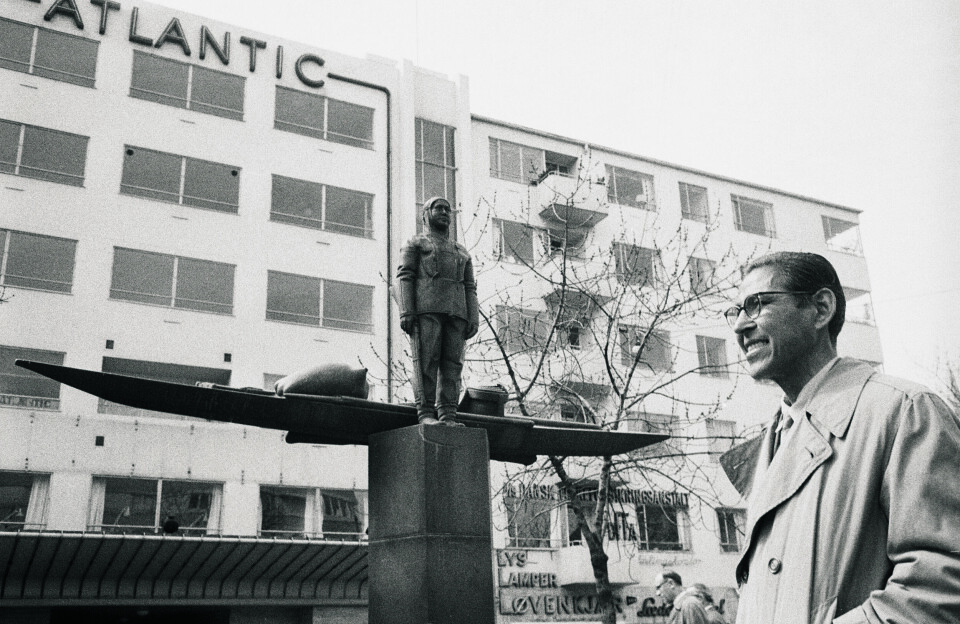
An autumn afternoon at Christianshavns Torv. Bicycles whizz by, strollers roll, and in front of the metro entrance stands a Greenlandic kayak man in bronze.
In front of him are four women: one is flaying a seal, one is cleaning a fish, one is catching small fish in the water, and one is enjoying the sun. Most people hurry past without paying any attention to them.
The Greenland Monument, created by sculptor Svend Rathsack in 1938, is for many just part of the city's inventory – a well-meaning symbol of the Commonwealth, without any real history.
But behind the figures lie stories about power, ideals and people. That is precisely what Astrid Nonbo Andersen and Martine Lind Krebs have set out to uncover in their new book “The Monument – Images of Greenland in Denmark throughout 100 years”.
With the monument as the focal point, they tell the great stories between Greenland and Denmark seen through three people who all in different ways became part of the Greenland image: the sculptor Svend Rathsack, the Greenlandic model and artist Emma Lynge and the kayaker Hans Christiansen (father of Thue and Ole Christiansen, ed.).
It is an ambitious undertaking. The authors do not merely want to describe the work and its genesis, but to let the three fates shed light on the entire Danish-Greenlandic relationship in the 20th century – from the legacy of the colonial era and the legal dispute with Norway over East Greenland at the Hague Court in the 1930s to the modern protests against Danish notions of Greenland. Along the way they involve a number of Greenlandic voices – politicians, artists and writers – who have all, in their own way, tried to come to terms with the Danish gaze.
The book is thorough, knowledgeable and well-written. The reader gets a lively and sometimes dramatic introduction to historical events that will be unknown to many. The sections on the case at the Hague Tribunal and the background to the creation of the monument are particularly strong. Here the authors want to show how deeply intertwined art and politics were – and how the bronze figures on Christianshavns Torv also became symbols in a larger narrative.
Yet The Monument is a book that balances between two ambitions that do not always go hand in hand: to write a comprehensive cultural history over several decades and at the same time create three personal portraits. It succeeds in part, but sometimes you lose direction. The story jumps from The Hague to Maniitsoq, from boxing to visual arts, from artist biography to political analysis – and you as a reader can lose the thread and ask: why do I need to know this now?
The authors themselves write that they “commit violence” (page 381, ed.) against Rathsack’s wish that his works should speak for themselves. And it is precisely here that the book’s weakness becomes apparent. Rathsack left no texts about the monument, and therefore the interpretations sometimes become too speculative. It is as if the authors insist that the work must mean something specific – and that something usually fits into the overall narrative of Danish colonial heritage and Greenlandic resistance.
This makes the book more interpretive than investigative. Voices that break the pattern are missing – for example, the Greenlanders who have long wanted a close relationship with Denmark. When the Atassut party first ran for election in 1979 on precisely that message, they got a great election result. These trends are supposedly not new – and that type of perspective would have given the book’s narrative more nuance.
That said, The Monument is an important and interesting book. It reminds us of how much history, power, and symbolism can be hidden in a piece of public art that we barely notice. And it shows how sensitive and volatile the relationship between Greenland and Denmark still is.
That Nonbo Andersen and Lind Krebs dare to interpret Rathsack – yes, perhaps “commit violence” to his silence – is in itself a brave choice. They pull the monument out of the city’s daily anonymity and back into the debate where it belongs. The book may be uneven, but it opens up an important space for conversation: Who tells the story of Greenland in Denmark – and who remains as silent figures in the square?
Abonnementer
Sermitsiaq.gl - web artikler
- Adgang til alle artikler på Sermitsiaq.gl
- Pr. måned kr. 59.00
- Pr. år kr. 650.00
Sermitsiaq - E-avis
- Adgang til Sermitsiaq e-avis som udkommer hver fredag
- Adgang til alle artikler på Sermitsiaq.gl
- Pris pr. måned kr. 191
- Pris pr. år kr. 1.677
AG - Atuagagdliutit E-avis
- Adgang til AG - Atuagagdliutit e-avis som udkommer hver onsdag
- Adgang til alle artikler på Sermitsiaq.gl
- Pris pr. måned kr. 191
- Pris pr. år kr. 1.677
Sermitsiaq.AG+
- Adgang til AG - Atuagagdliutit e-avis som udkommer hver onsdag
- Adgang til Sermitsiaq e-avis som udkommer hver fredag
- Adgang til alle artikler på Sermitsiaq.gl
- Adgang til Arnanut e-magasin
- Adgang til Nutserisoq.gl
- Ved interesse send en mail til abonnement@sermitsiaq.gl
Kære Læser, Velkommen til Sermitsiaq.gl – din kilde til nyheder og kritisk journalistik fra Grønland. For at kunne fortsætte vores vigtige arbejde med at fremme den frie presse og levere dybdegående, kritisk journalistik, har vi indført betaling for udvalgte artikler. Dette tiltag hjælper os med at sikre kvaliteten af vores indhold og støtte vores dygtige journalister i deres arbejde med at bringe de vigtigste historier frem i lyset. Du kan få adgang til betalingsartiklerne fra kun kr. 59,- pr. måned. Det er nemt og enkelt at købe adgang – klik nedenfor for at komme i gang og få fuld adgang til vores eksklusive indhold. Tak for din forståelse og støtte. Dit bidrag hjælper os med at fortsætte vores mission om at levere uafhængig og kritisk journalistik til Grønland.