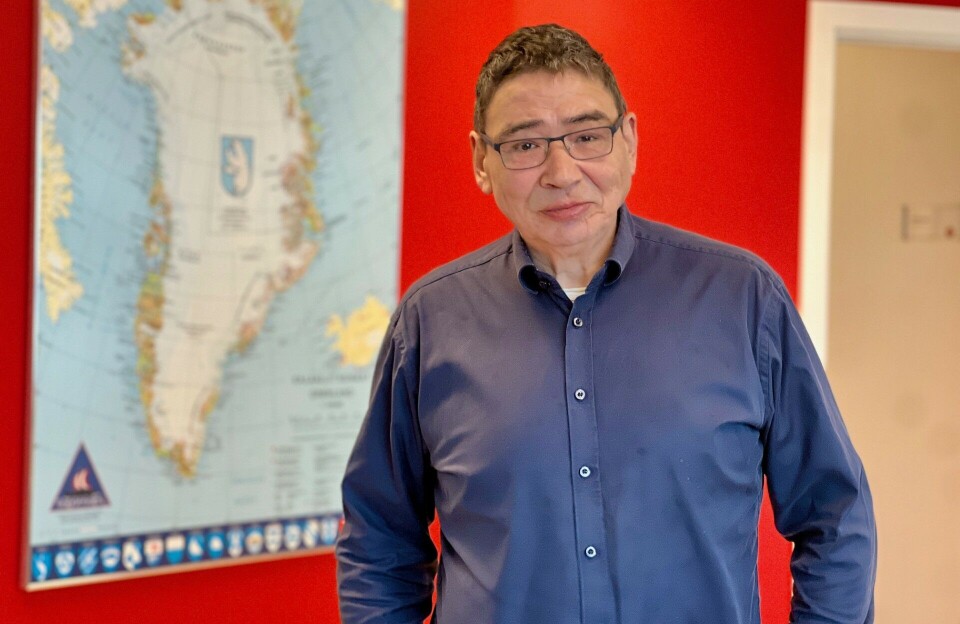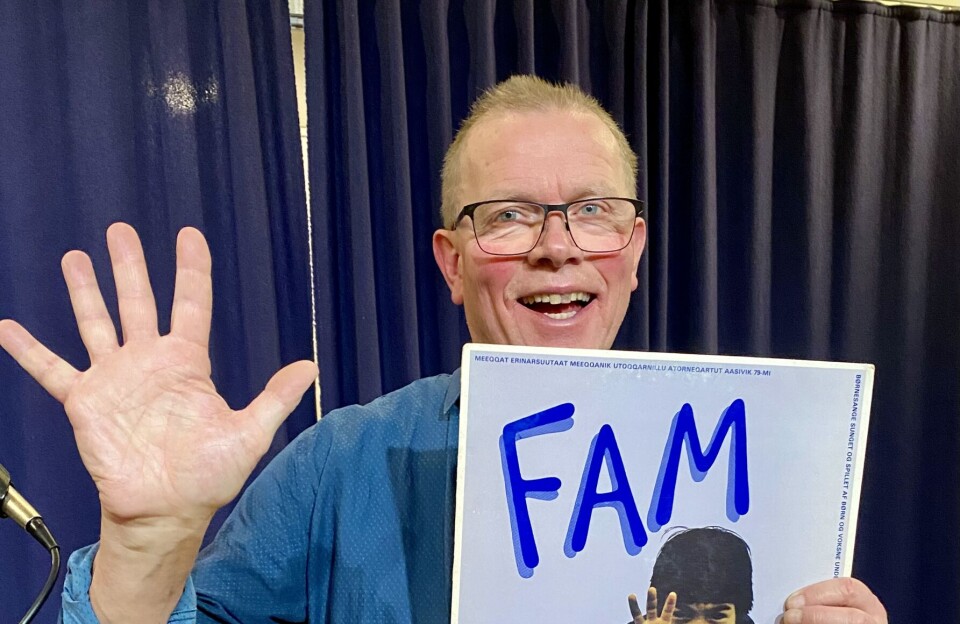
When Christian Søgaard stood with his graduation cap in hand in Sønderborg in 1976, he knew only one thing for sure: He wanted to go out into the world.
To experience something that extended beyond both high school and South Jutland. The Lidegaard family, whom he knew through friendship, suggested Greenland – and soon after, he stood in Nuuk with suitcase in hand, equipped with a role that he later described with a smile as “a kind of kiffaq” with a local family.
- The goal was to have an adventure, and I did. I just dropped into a cultural and political revolution, says the then adventurous student.
It was the start of a lifelong relationship with Greenland in general – and with Greenlandic culture and music in particular. So strong that today he still plays Greenlandic music at Danish venues, among others together with Rasmus Lyberth, whom he will have known for 50 years next year. Together, they have performed at the Royal Albert Hall in London, and in November he provided the musical accompaniment when Lyberth was inducted into the Hall of Fame at Tønder Festival – together with Lyberth's other musicians and Aviaaja Lomholt.
In addition, Christian Søgaard gives lectures on Greenland's musical history – most recently on a Thursday in November in Svendborg, where he also lives and works, among other things, as a church organist. He says:
- I am telling you about three thousand years of musical history. From the first drums, through the colonial era encounters between European and Greenlandic musical language, to the modern struggle for identity in rock, pop and folk. Music is a history book in itself – and you understand Greenland better when you hear how it has sounded.
A city in transition – and a young music scene in liberation
Nuuk in 1976 was a place where nothing stood still. Home rule negotiations rumbled in the background, youth organized themselves into new, Greenlandic-speaking communities, and a whole new wave of musical self-awareness was taking shape.
As a newcomer, Christian did the only logical thing: He threw himself into it all. He lived with a journalist on KNR and quickly became a part of the radio program Ungforum together with Minik Rosing and Bo Lidegaard, among others. He also learned the Greenlandic polkas – kalattuut – by sitting close to older musicians and writing down the melodies, note by note, in the semi-dark winter light. He learned a little Greenlandic, enough to understand the jokes and sing along to the quick dances.
"I realized that music was the language we all knew," he remembers.
- When you played, you were equal to each other. So simple and so strong.
Aasivik – where a people spoke for themselves
In the late 1970s, Christian became a regular part of the Aasivik gatherings at Aasiaat – large cultural and political summer camps where Greenland discussed its future in Greenlandic for the first time, and where alcohol was prohibited. The atmosphere was intense, innovative and euphoric.
- There was a feeling that something completely new was being created. And it was crazy to be a part of it – as a Dane, 20 years old.
Here he met, among others, Kuupik Kleist, Malik Høegh and Juaaka Lyberth, as well as a number of other musicians and activists who would play central roles in Greenland's modern cultural history. He played at campfires, recorded songs and made new friends who would follow him for decades.

ULO – and the encounter with a musical awakening
Even after he moved back to Denmark in 1978 to attend the music conservatory, Greenland never left him. He became affiliated with the record label ULO, and from the head office in Copenhagen he participated in a long series of projects that are now part of Greenland's modern music canon.
He helped record the album, The Flying Kayak, where children from Uummannaq told stories that were turned into songs. He got to know Karsten Sommer and Anders Dohn – and together they created recordings that are still played in Greenlandic homes.
- The incredible thing was that everything was played, says Christian.
- There was an explosive hunger for Greenlandic music. People wanted to hear themselves, their language, their stories. It was a fantastic experience.
South Greenland – and the music that hid in the settlements
One of the most memorable projects was a trip to South Greenland with Kuupik Kleist and Anders Dohn to record fiddle music in the villages. From living rooms to community centers, from accordion to drum dance.
“It was a gold mine,” he says.
- Each settlement had its own musical tone.
The journey became both a book and a CD – and for Christian it became a strong reminder that music is not just entertainment, but cultural heritage.
Rosa Ville – and an evening you won't forget
Even after he became part of the Tukaq Theatre ensemble in West Jutland, his Greenlandic traces continued. One evening, when he was playing one of the Rosa Ville melodies – popular Greenlandic dance numbers – something unexpected happened.
- Suddenly someone pulls me by the sleeve of my shirt and says: ‘That’s my music you’re playing.’
It turned out to be Rosa Ville herself. She had not performed for many years, and the audience stopped dancing, stared up at her, and whispered, “Where have we heard her before?”
There was both laughter and tears that night.
When the throat singing sounded in Nuuk for the first time
Another memorable moment occurred in the Nuuk Hall during the recording of an ICC concert, where Inuit musicians from Canada and Alaska participated. Christian was sitting in the sound box with Karsten Sommer when throat singing – katajjaq – was heard for the first time.
“It was completely incomprehensible,” he says.
Karsten went outside to hear what it sounded like in the hall, and came back laughing:
“It sounds the same outside!”
A line through a life
When Christian Søgaard looks back on the two years in Nuuk and his long association with Greenlandic culture, it is clear that the stay changed everything: his music, his life path, his identity.

- I thought I was going to get to know a new place, he says, and continues:
- But it turned out that it was the music that taught me something about people. It opened all the doors.
And perhaps that is the explanation for how a young man from Sønderborg ended up becoming one of the few Danes who has played his way into the heart of Greenland's modern music scene - without people necessarily knowing that the tone on their old cassette tapes also bore his hand.
Abonnementer
Sermitsiaq.gl - web artikler
- Adgang til alle artikler på Sermitsiaq.gl
- Pr. måned kr. 59.00
- Pr. år kr. 650.00
Sermitsiaq - E-avis
- Adgang til Sermitsiaq e-avis som udkommer hver fredag
- Adgang til alle artikler på Sermitsiaq.gl
- Pris pr. måned kr. 191
- Pris pr. år kr. 1.677
AG - Atuagagdliutit E-avis
- Adgang til AG - Atuagagdliutit e-avis som udkommer hver onsdag
- Adgang til alle artikler på Sermitsiaq.gl
- Pris pr. måned kr. 191
- Pris pr. år kr. 1.677
Sermitsiaq.AG+
- Adgang til AG - Atuagagdliutit e-avis som udkommer hver onsdag
- Adgang til Sermitsiaq e-avis som udkommer hver fredag
- Adgang til alle artikler på Sermitsiaq.gl
- Adgang til Arnanut e-magasin
- Adgang til Nutserisoq.gl
- Ved interesse send en mail til abonnement@sermitsiaq.gl
Kære Læser, Velkommen til Sermitsiaq.gl – din kilde til nyheder og kritisk journalistik fra Grønland. For at kunne fortsætte vores vigtige arbejde med at fremme den frie presse og levere dybdegående, kritisk journalistik, har vi indført betaling for udvalgte artikler. Dette tiltag hjælper os med at sikre kvaliteten af vores indhold og støtte vores dygtige journalister i deres arbejde med at bringe de vigtigste historier frem i lyset. Du kan få adgang til betalingsartiklerne fra kun kr. 59,- pr. måned. Det er nemt og enkelt at købe adgang – klik nedenfor for at komme i gang og få fuld adgang til vores eksklusive indhold. Tak for din forståelse og støtte. Dit bidrag hjælper os med at fortsætte vores mission om at levere uafhængig og kritisk journalistik til Grønland.