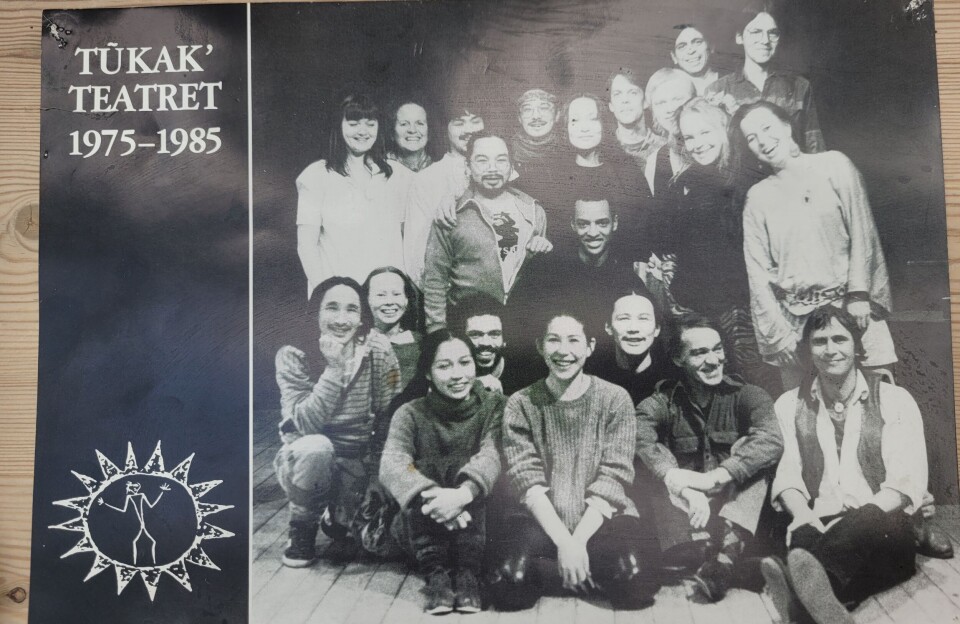
When the masks, stories and rhythms of Tuukkaq Theatre filled Dalgården in Fjaltring, it was more than just a theatre that took shape.
It was a cultural experimentarium, a place where Greenlandic traditions, international theatre practice and local life in West Jutland merged into something completely new.
Today the buildings no longer stand – they were demolished in 2025, shortly after the death of the founder, the Norwegian Reidar Nilsson – but the legacy of Tuukkaq lives on stronger than the brickwork. It lives on in people, in movements, in memories and in the history of Nordic theatre.
The memories have been reproduced in the chapter in the exhibition booklet for the Hans Lynge exhibition, which was held at the Museum of Religious Art in Lemvig until recently.
The author of the chapter is art historian Laila Lund Altinbas, who has interviewed a number of key people who have been associated with Tuukkaq over the years.
A meeting between Fjaltring and the world
From the beginning in the late 1970s, Tuukkaq was conceived as a place where cultures would meet and reflect each other. Young actors from Greenland came here to develop – and artists, musicians and theatre people from all over the world came here to learn from Inuit body language, mask work and storytelling traditions.
The Greenlandic theatre was not a closed space; it was a magnet for its surroundings, not least for the local area, including Lemvig, the nearest town to Fjaltring. Former principal of the town's high school, Lars Ebbensgaard, tells how the meeting with Tuukkaq's founder, Reidar Nilsson, influenced both the school and the entire region. Artists and actors flocked to the school, and the development of the high school became closely linked to the burgeoning theatre scene.
"I couldn't have made it through high school without Tuukkaq," he says today – a testament to how the theater unfolded in the local community.

According to the now retired principal, Tuukkaq Theatre thought in a new way - as an exchange between bodies, words, cultures and stories. One of the projects where the theatre and the local high school collaborated was in 1985, where they became involved in a youth project. Lars Ebbensgaard says:
- Young people from Manhattan and Lemvig were to get to know each other through theatre. During the period, they drew, danced, made masks and talked about everything that is difficult to say without the help of art. It became one of Tuukkaq's great breakthroughs as a cultural bridge builder and was later repeated in New York.
Another theatre project where the theatre toured internationally was the play Inuit, which was re-performed several times. One of the show's prominent actors, Vivi Nielsen, who toured internationally and became an iconic piece for the ensemble, says:
- Tuukkaq didn't just give young people a voice; it gave them a language that went beyond words.
The meeting between tradition and modernity
Tuukkaq Theatre also had a special connection to the multi-artist Hans Lynge, who is the main figure of the exhibition this chapter is part of.
Hans Lynge taught at Tuukkaq's theatre school and brought his knowledge of Greenlandic myths, storytelling techniques and theatre history into the teaching. But it wasn't just theory he passed on – it was a look at people, at creativity, at identity.
One of the students, Bendo Schmidt, remembers the moment when Hans Lynge stood in front of a blank canvas on an easel and asked the students to imagine everything that had not yet taken shape. Only then did he begin to paint.
It wasn't a lesson about painting. It was a lesson about courage, imagination, and intuition – about creating from the place where tradition and the present meet.
This mutual inspiration went both ways. Vivi Nielsen says it precisely:
- Hans Lynge meant a lot to Tuukkaq – and Tuukkaq meant a lot to Hans Lynge.
For Hans Lynge, Tuukkaq's work with mask dance and bodily storytelling was living proof that Greenlandic culture could be modern without losing its foundation.
Myths as modern expressions
Tuukkaq also gave Greenlandic legends and myths a new voice. Pieces like Inuit and the many improvised mask plays, drew threads back to Inuit tradition, but were shaped with a modern, experimental expression. This was in line with Hans Lynge's own conviction: that one should not copy the past, but use it as a foundation for something new.
At the same time, Tuukkaq addressed colonial history directly – both in the choice of material and in the way the ensemble worked with cultural encounters and conflicts. Hans Lynge found himself at home here; his own satirical and critical works from the 1930s, such as Juulleruttulersut/Juletravlhed, had been precursors to precisely such an exploration of power, identity and coexistence.
When theatre changes lives
Tuukkaq's importance can also be measured in the people who passed through the theatre. Several returned to Greenland and became pioneers in modern Greenlandic theatre, among them Simon "Mooqqu" Løvstrøm, Makka Kleist and Elisabeth Heilmann Blind. The latter two brought the traditions to Sámi communities in Scandinavia or continued in international contexts.
Vivi Nielsen tells of a career that took her from Fjaltring to Europe, Alaska and the White House, where she performed a masquerade for Hillary Clinton. For her – and for many others – Tuukkaq became the gateway to the world.

Tuukkaq Theatre officially closed in 1994, but continued as a living museum and meeting place until Reidar Nilsson's death in 2024. The following year, Dalgården was demolished. But the contents of the theatre did not disappear.
The archives have now been transferred to the National Museum and Archive of Greenland, and the history is secured for posterity. As Daniel Thorleifsen puts it:
- Tuukkaq Theatre was an important cultural institution during a time of change. The first Greenlandic actors were trained here, and the foundation for modern Greenlandic theatre was created here.
What began as a wild experiment in a West Jutland village grew into a movement that shaped lives, artists and theatre history far beyond Denmark's borders.
Tuukkaq no longer stands as a building. But as an idea, as a method and as a meeting between people, it is still alive.
Abonnementer
Sermitsiaq.gl - web artikler
- Adgang til alle artikler på Sermitsiaq.gl
- Pr. måned kr. 59.00
- Pr. år kr. 650.00
Sermitsiaq - E-avis
- Adgang til Sermitsiaq e-avis som udkommer hver fredag
- Adgang til alle artikler på Sermitsiaq.gl
- Pris pr. måned kr. 191
- Pris pr. år kr. 1.677
AG - Atuagagdliutit E-avis
- Adgang til AG - Atuagagdliutit e-avis som udkommer hver onsdag
- Adgang til alle artikler på Sermitsiaq.gl
- Pris pr. måned kr. 191
- Pris pr. år kr. 1.677
Sermitsiaq.AG+
- Adgang til AG - Atuagagdliutit e-avis som udkommer hver onsdag
- Adgang til Sermitsiaq e-avis som udkommer hver fredag
- Adgang til alle artikler på Sermitsiaq.gl
- Adgang til Arnanut e-magasin
- Adgang til Nutserisoq.gl
- Ved interesse send en mail til abonnement@sermitsiaq.gl
Kære Læser, Velkommen til Sermitsiaq.gl – din kilde til nyheder og kritisk journalistik fra Grønland. For at kunne fortsætte vores vigtige arbejde med at fremme den frie presse og levere dybdegående, kritisk journalistik, har vi indført betaling for udvalgte artikler. Dette tiltag hjælper os med at sikre kvaliteten af vores indhold og støtte vores dygtige journalister i deres arbejde med at bringe de vigtigste historier frem i lyset. Du kan få adgang til betalingsartiklerne fra kun kr. 59,- pr. måned. Det er nemt og enkelt at købe adgang – klik nedenfor for at komme i gang og få fuld adgang til vores eksklusive indhold. Tak for din forståelse og støtte. Dit bidrag hjælper os med at fortsætte vores mission om at levere uafhængig og kritisk journalistik til Grønland.