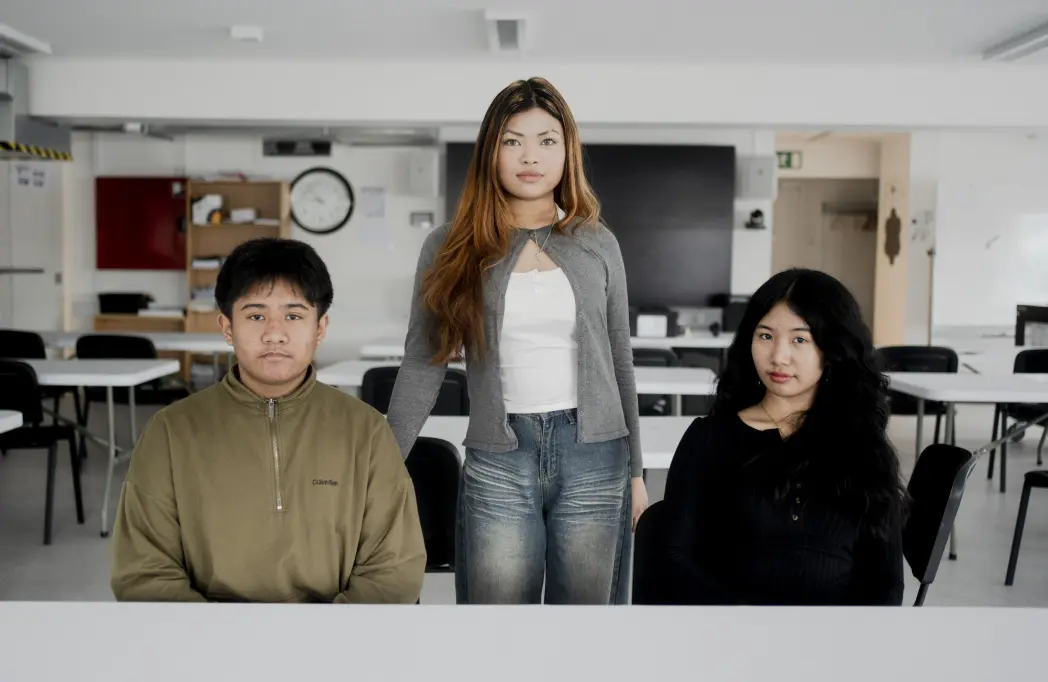
When the teacher speaks Greenlandic to the whole class, the four students sit quietly and try to follow.
Not because they understand what is being said, but because they have become accustomed to a school life where the essentials only fall into place afterwards.
Only then does the teacher come to them and explain in English – if she can. If not, well, then they have to rely on each other – or figure it out themselves.
The four students who sit and try to make the lesson make sense are all in 10th grade at Atuarfik Inussuk in Nuuk.
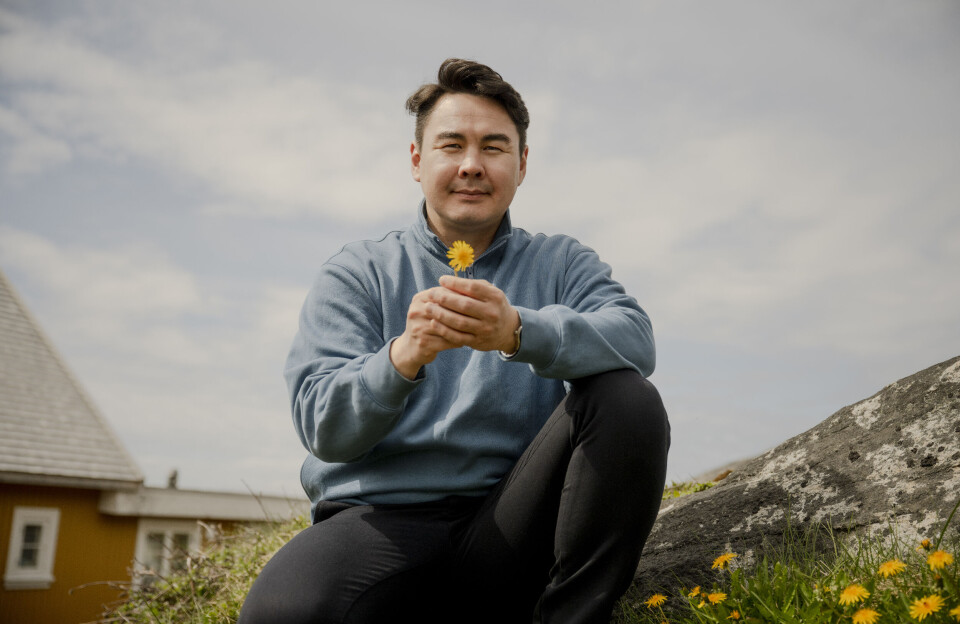
Cyrille Jhoy, Shanelle Pampoza, Samuel Del Rosario and Aelred Malix Esguerra Cortez came to Greenland at primary school age and have therefore not had the opportunity to learn Greenlandic from the beginning, like many of their classmates.
For them, it has become part of everyday life that language often gets in the way – and understanding the teacher cannot be taken for granted. For the same reason, the interview is conducted in English.
- Danish is the language I understand best. Greenlandic is much more difficult for me, explains Shanelle Pampoza, who has lived in Nuuk for four years.
For the other students, the picture is the same – only even more pronounced. According to Samuel Del Rosario, who has been in the country for two years, he hardly understands Greenlandic, while Cyrille Jhoy, who has been here for a year and a half, has difficulties with both languages, but still prefers Danish because it is easier to translate into English.
The article is a follow-up to the article: When language fails in the classroom, where AG spoke with two researchers who have been working with Asian students in primary school.
Community makes the difference
Still, the four are in a way among the lucky ones. There are more of them together in the class. They can support each other, translate along the way and share their experiences. Several of them themselves point out that it makes a decisive difference.
Because in many other parts of the country, Asian students sit alone in the classroom – without anyone to lean on when the teaching is in a language they do not understand.
Here in Nuuk, at least they have each other, and it is more than just a community. It is a concrete prerequisite for being able to keep up with just a little bit.
That is no small point. Because it was precisely loneliness that filled the previous article, where researchers described how Asian students in Greenland often stand alone – academically and socially. Compared to that, the situation of the four students almost appears as an exception.
Shanelle Pampoza knows the contrast inside out. She says:
- When I started in 7th grade, I was all alone. It was very difficult. Later, another student came, and only in 9th and 10th grade we were brought together with more Asian students in the same class. That makes it easier, because we can help each other.
You can feel the difference in everyday life. Not because the language difficulties have disappeared, but because they are no longer alone with them.
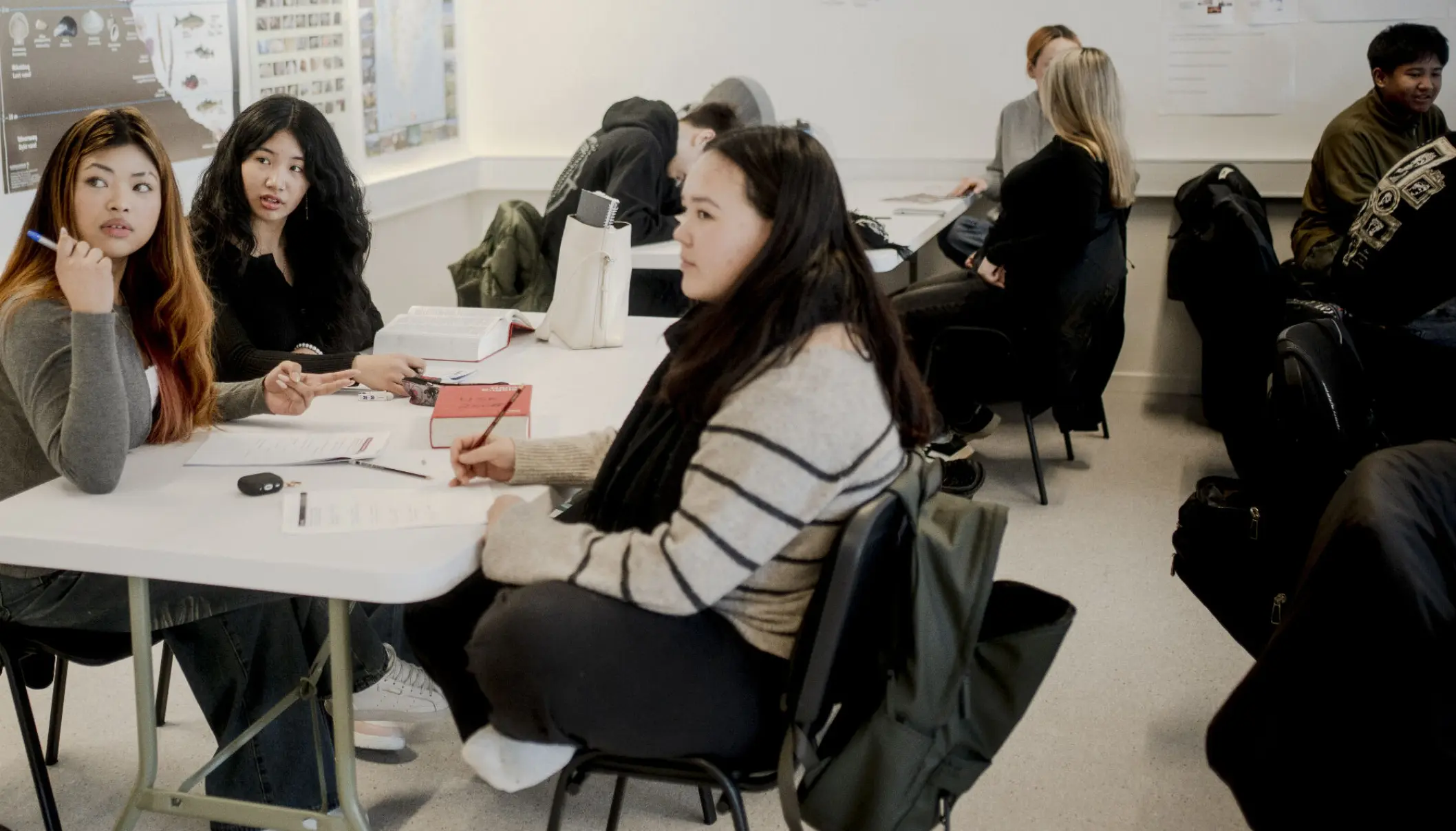
What perhaps impresses the four students most is how quickly responsibility shifts. If the teacher can't explain the material in a way they understand, it becomes their own problem, says one of them.
Then they have to find their own way into the lesson – by asking classmates, reading out loud on their own or trying to figure out what's going on.
Help is vulnerable
For Samuel Del Rosario, it's clear what the problem is. The school system is not designed for students who don't speak Greenlandic or Danish well enough to follow the lessons.
- There should be more teachers who can speak English – not only for us, but also for the students who will come in the future, he says.
When he looks at his own school week, he estimates that only one teacher really speaks good English. This makes the help vulnerable. If that particular teacher is not there, it immediately becomes more difficult to keep up.
Cyrille Jhoy points out that there used to be some kind of extra linguistic support at the school.
- We were taken out of the regular lessons and put in another room with a teacher who could speak Greenlandic, Danish and English. There we learned the basics, and that made it easier to keep up, he says.
It wasn't a perfect solution, she emphasizes, but it was a help. Today, the offer is no longer available in the same way.
For Cyrille, the wish is not unrealistic either. It's not about miracles, but about something more down to earth: a better introduction to the school and the languages when foreign students arrive in Greenland.
An introductory course, more teachers with English skills – and a school system that is more prepared for the fact that not all students will turn up with Greenlandic or Danish.
The language determines their future
The future is a big deal for the four students. They want to continue in the education system – at GU and then at university – but the path to get there is through Danish, and that creates uncertainty.
- I would like to continue at GU, but I have doubts whether my Danish is good enough, says Shanelle Pampoza, emphasizing that the language will be crucial for their opportunities.
Because even though the ambitions are there, they still lack the prerequisites to be on an equal footing with their classmates. She continues:
- When we don't understand the teacher, we have to figure it out ourselves. This means that some of us have private lessons paid for by our parents.
Abonnementer
Sermitsiaq.gl - web artikler
- Adgang til alle artikler på Sermitsiaq.gl
- Pr. måned kr. 59.00
- Pr. år kr. 650.00
Sermitsiaq - E-avis
- Adgang til Sermitsiaq e-avis som udkommer hver fredag
- Adgang til alle artikler på Sermitsiaq.gl
- Pris pr. måned kr. 191
- Pris pr. år kr. 1.677
AG - Atuagagdliutit E-avis
- Adgang til AG - Atuagagdliutit e-avis som udkommer hver fredag
- Adgang til alle artikler på Sermitsiaq.gl
- Pris pr. måned kr. 191
- Pris pr. år kr. 1.677
Sermitsiaq.AG+
- Adgang til AG - Atuagagdliutit e-avis som udkommer hver fredag
- Adgang til Sermitsiaq e-avis som udkommer hver fredag
- Adgang til alle artikler på Sermitsiaq.gl
- Adgang til Arnanut e-magasin
- Adgang til Nutserisoq.gl
- Ved interesse send en mail til abonnement@sermitsiaq.gl
Kære Læser, Velkommen til Sermitsiaq.gl – din kilde til nyheder og kritisk journalistik fra Grønland. For at kunne fortsætte vores vigtige arbejde med at fremme den frie presse og levere dybdegående, kritisk journalistik, har vi indført betaling for udvalgte artikler. Dette tiltag hjælper os med at sikre kvaliteten af vores indhold og støtte vores dygtige journalister i deres arbejde med at bringe de vigtigste historier frem i lyset. Du kan få adgang til betalingsartiklerne fra kun kr. 59,- pr. måned. Det er nemt og enkelt at købe adgang – klik nedenfor for at komme i gang og få fuld adgang til vores eksklusive indhold. Tak for din forståelse og støtte. Dit bidrag hjælper os med at fortsætte vores mission om at levere uafhængig og kritisk journalistik til Grønland.